
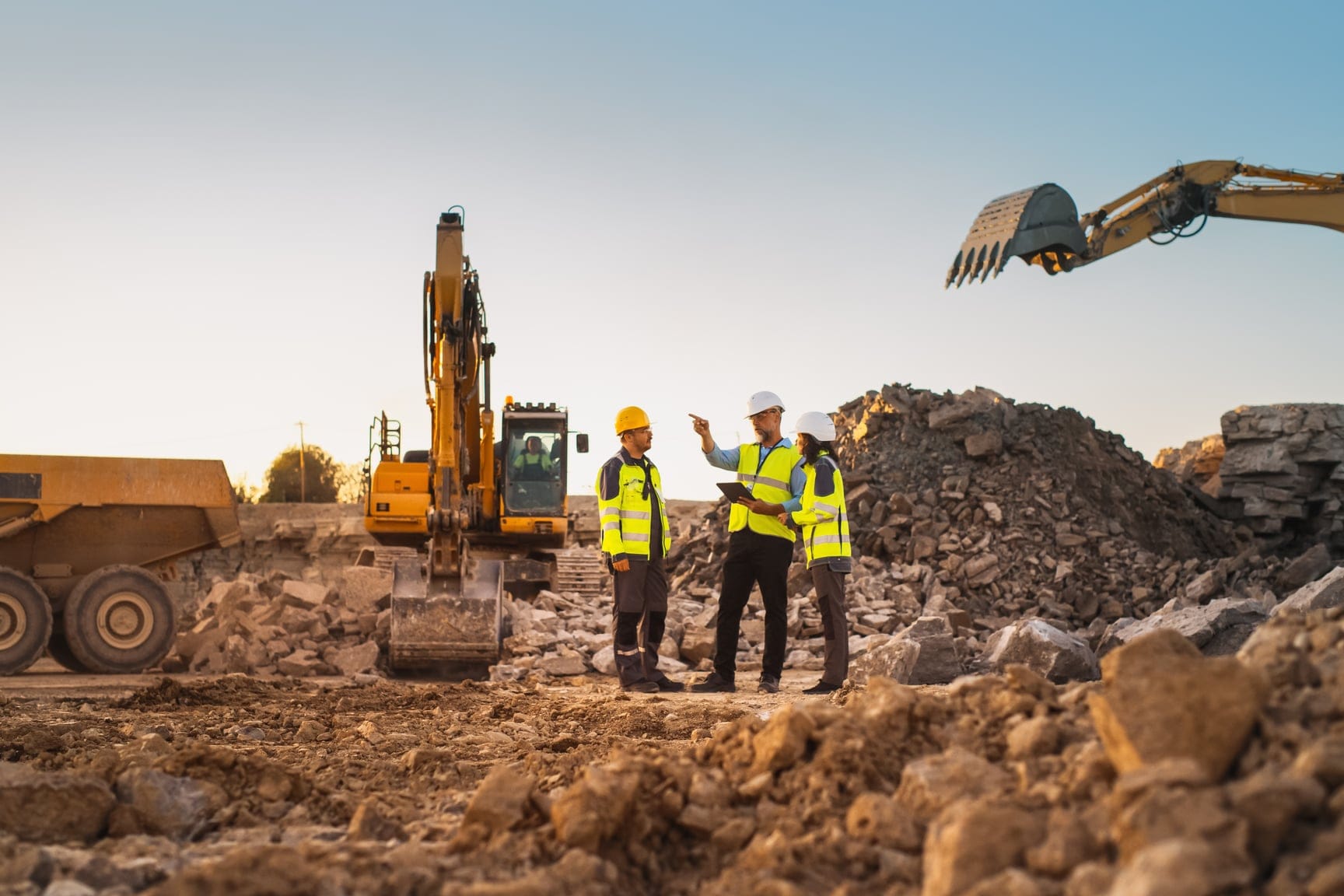
An excavation business in North Dakota works under three stated rules. Before any excavation begins, a notice goes to the notification center, except in an emergency. Workers’ compensation is obtained from the state fund, Workforce Safety and Insurance. And the owner’s policy limits for a vehicle are printed in the financial-responsibility chapter of the Century Code. Everything else a crew needs is a question to put to the right office.
Sort the paperwork in that order: the notice, the fund, the trucks, then the rest of the program. Our agency works on the other five policies that sit beside the state fund, and you can read the whole picture under excavation insurance. The sections below mark each open point once, with the office to ask.
North Dakota One-Call, Incorporated, and the notice before the first cut
The state’s one-call chapter is titled One-Call Excavation Notice System, and its excavation section is headed “49-23-04. Excavation”. The duty reads: “Except in an emergency, an excavator shall contact the notification center and provide an excavation or location notice before beginning any excavation.” Century Code citation. The same chapter defines an excavator as a person who conducts excavation, which is the wording the definition section uses.
The statute names the body behind the center: “A nonprofit corporation, North Dakota one-call, incorporated, shall govern the notification center.” Century Code citation. The definition of the locate period then reads: “The forty-eight hour period beginning at 12:01 a.m. of the day after the location request was submitted to the notification center; excluding any Saturday, Sunday, or holiday.” Century Code citation. Look the nonprofit up by its name for current contact details before you schedule a dig.
Whatever the contact route, keep a written note of each notice: the date it was made, the work described and the person who made it. When an underwriter, a claims reader or a general contractor asks whether the ground was marked before the bucket went in, that note is the paper to reach for. Clip it to the contract and the site sketch.
The note also helps the owner who hires out part of the digging. If a trucker or a trenching sub opens the ground on your job, write down who made the notice and who received it. Your agent may ask, and so may the party who hired you.
The diagram follows a job in order. A notice goes to the notification center and is written down. The marks and the job description are compared with what the crew finds. A machine opens a buried service belonging to someone else. A claim reader may then set the policy terms beside the job paperwork. No figures are shown.
A line opened on a North Dakota job, and what the insurance paperwork turns on
When a machine opens a buried gas, water, power or communications line, someone outside your company has a loss, and that damage to another person’s property is the exposure an excavation owner worries about first. Three things shape how a claim on a general liability policy is read: the work as the application describes it, the limits you bought and the contract signed for the job.
The application description matters because it states the work the owner says the company does. If the crew grades building pads, trenches for utility lines, digs basements and runs a hydro excavation truck, the application should say all four. A company that describes only light grading and then opens a trench for a water line has a conversation to have, and it is better held before the loss than after it.
Limits matter because a struck main may be repaired by a utility, a city crew or a contractor working for them, and the repair is a separate matter from the dig you planned. The contract matters because the prime contractor or the owner of the property may have written an indemnity clause, an additional-insured requirement or a notice deadline into it. Tell your agent about a loss promptly, and send the note of the notice, the job description and photographs of the site.
Keep the crew’s own account, too: who ran the machine, who watched the cut and what was marked on the ground. A claim reader may compare the story with the notice, and a story that matches the paperwork is easier to follow.
The Secretary of State’s contractor license and the question it leaves open for excavation
North Dakota’s contractors chapter names the Secretary of State as the licensing body. Its license rule reads: “A person may not engage in the business nor act in the capacity of a contractor within this state when the cost, value, or price per job exceeds the sum of four thousand dollars.” Century Code citation. That is a general contractor license, and it is not stated to reach excavation work as a separate trade.
Whether grading, trenching or basement digging carries its own credential is unconfirmed here, and the Secretary of State’s office is the body to ask. Carry the answer into your application, because an underwriter may ask whether you hold a license and under what name.
Workers’ compensation for a North Dakota crew starts at Workforce Safety and Insurance
North Dakota’s statute states the duty this way: “An employer may not employ any person, or receive the fruits of the labor of any person, in a hazardous employment as defined in this title, without first applying for workforce safety and insurance coverage.” Century Code citation. Coverage is bought from the state fund, Workforce Safety and Insurance, and is not placed through private insurers. We do not offer to place it. Our agency works on the other five policies in an excavation program and leaves the compensation policy with the fund that writes it.
On the owner, the fund’s common-questions page says: “an employer may choose to purchase elective coverage for himself/herself and for any employees otherwise exempt. This coverage is not required by law.” Workforce Safety and Insurance citation. If you run the machine yourself, put that sentence in front of the fund and ask how it applies to you.
The point where coverage begins by payroll size is unconfirmed, and Workforce Safety and Insurance can answer it. When you call, have the payroll for the operators, the laborers, the drivers and the foreman at hand, so the fund can speak to each job on your crew.
Owner’s policy limits in North Dakota’s financial-responsibility chapter, and the commercial question
The state’s proof-of-financial-responsibility chapter sets these limits for an owner’s policy:
“twenty-five thousand dollars because of bodily injury to or death of one person in any one accident and subject to said limit for one person, fifty thousand dollars because of bodily injury to or death of two or more persons in any one accident, and twenty-five thousand dollars because of injury to or destruction of property of others in any one accident”
A separate commercial or motor-carrier minimum for a loaded dump truck is unconfirmed. Ask your agent which limit applies to a dump truck when you build the vehicle list, and whether your trucks should carry more than the owner’s policy limits printed in the chapter.
An excavation business may list the dump truck, the pickup that pulls the trailer, the trailer that carries the machine and every driver who takes them to a site. Tell the application which vehicles haul material, which only carry tools and which go on public roads. Ask about vehicles you rent for a busy month, too, because a rented truck may belong on the list.
A stack of labeled layers, top to bottom: North Dakota call-before-you-dig center; Workforce Safety & Insurance; North Dakota Insurance Department; Secretary of State; Your agent, with each reply. No figures are shown.
Coverage lines for a North Dakota dirt business, from the trench to the yard
General liability for a locate that missed a line
A cut can reach a line the marks did not show, and the person whose property is damaged or hurt may not work for you. A general liability policy may be the one a claim is made against, and its terms, its limits and the work described on your application shape the answer. The notice you gave the notification center, and your written note of it, may be among the papers a claim reader asks to see. Name the real jobs on the application, whether grading, trenching, basements or hydro work, so the paperwork reflects what the crew does.
Workers’ compensation through Workforce Safety and Insurance
The people who run the loader, set the pipe and drive the truck are your payroll, and the state’s hazardous-employment duty is to apply for coverage with the fund before employing a person in that work. Workers’ compensation is obtained from Workforce Safety and Insurance, and we do not place it. What the agency can do is read your other policies with that fund in mind, so the descriptions of payroll and duties match across the paperwork.
Commercial auto for the truck that carries the machine
A machine reaches the job on a trailer behind a truck, and the spoil leaves in another truck. Commercial auto insurance is written on the vehicles you list. The commercial-vehicle minimum is unconfirmed, so ask your agent which limit applies to a dump truck. Name every driver who takes a loader, a trailer or a truck onto a public road, so the schedule matches who actually drives.
Contractors equipment for the iron you own or lease
An excavator, a loader and a trencher can be worth more than the truck that moves them, and the attachments may be worth more than anyone remembers. Contractors equipment insurance may respond to physical loss of a machine on its terms. Write each machine’s make, year and serial number into the schedule, name the attachments, and say where the machine is kept overnight. If you lease the iron, the lease may name who insures it, and your agent can read that clause with you.
Umbrella over the working policies
A struck main, a collapsed trench wall or a loaded truck on a road can produce a loss that is larger than the limit on a working policy. An umbrella policy may add limits above the general liability and commercial auto policies, on its terms. A contract may ask for a stated umbrella limit, so read that clause before you bid, and have your agent show where each underlying policy ends and the umbrella begins.
Property insurance for the building and the contents you own
A shop, an office, a fuel tank and a yard of parts all hold value that the machines do not. Property insurance may respond to loss of the building and the contents you own, on its terms. List what is in each building and what stands in the yard. Tell the agent about anything stored for another company, because a policy may treat another person’s property differently from your own. When you are ready to talk about all six, start a quote request.
Basement, pad and trench jobs: how a North Dakota application sorts the work
An application asks you to name the work, and the names it uses are plain ones. Naming each job gives the underwriter a clear picture of the exposure, so answer it job by job.
General excavation
Opening ground for a building, a lot or a drainage cut with a track or wheel machine. Say who owns the site, what is built over it afterward and whether a utility line is likely nearby. Say, too, whether the spoil stays on the site or leaves it, because hauling belongs on the vehicle list.
Land grading and building pads
Shaping ground to level for a slab or a road. An application may ask how large the area is and whether you haul material to or from it. Name the machines that do the grading, since each belongs on the equipment schedule.
Site preparation
Clearing the way for a builder: stripping ground cover, rough grading and staking. Say whether your crew or a subcontractor does each step, and whether you work under a general contractor’s direction or for the property owner.
Utility and trench work
Opening a ditch for water, sewer, gas, power or communications lines. The notice carries real weight here, so tell the application whether you or the utility sets the marks, and keep your written note of each notice.
Basement and foundation digging
Cutting a hole for a basement or footings next to a building or a property line. An application may ask how close the cut comes to an existing structure and whether shoring is used. Describe the neighbors’ buildings if they stand near the cut.
Hydro excavation
Opening ground with pressurized water and a vacuum truck. Describe the truck as equipment and as a vehicle, because it may belong on both lists, and say who operates it.
Application questions for a North Dakota excavation company
An application asks what you do, where you do it, what you own, who works for you and what you have signed. For an excavation company the questions run in this order: the kinds of work, the machines and their values, the trucks and drivers, the subcontractors, the sites and the contracts.
Answer about the work you do now, and about the work you expect to take in the next year. A company that adds hydro excavation after the policy starts has changed its exposure, and an underwriter may want to hear it. If you are starting out, say so plainly, name your experience, and list every machine you have bought or leased. A new company is easier to quote when its application is complete.
Subcontractors need a line of their own. If you hire a trucker or another digging outfit, ask for their certificates and keep them. An underwriter may ask whether the people you hire carry their own policies. Our agency can read a subcontractor’s certificate with you.
Who takes which question in North Dakota
Workforce Safety & Insurance handles workers’ compensation, so payroll and employer coverage questions go there. The North Dakota Insurance Department is the insurance regulator. The Secretary of State is the licensing body, so questions about a contractor license go there. For the commercial-vehicle minimum, talk to your agent.
The notice before digging goes to the notification center that North Dakota One-Call, Incorporated governs.
What a North Dakota prime contract or city bid may ask you to show
A general contractor, a city or a school district may write insurance requirements into a bid. A contract may ask for a certificate naming it as an additional insured, a stated limit for general liability, an umbrella and proof of workers’ compensation. A certificate is a summary the agent prepares, so read the contract’s insurance article against the policies you actually carry before you sign. Bring a certificate request to your agent early.
Contracts for utility and trench jobs may also ask about the notice before digging, so keep your written notes available.
Public owners may add their own paperwork, such as a bid bond or a permit, that sits outside the insurance program. Read the whole package, mark every clause that mentions insurance and send those pages to your agent with the bid date written on top.
A pre-bid checklist for the North Dakota office and the cab
- The date and a written note of each notice to the notification center.
- Your answer from the Secretary of State on whether excavation carries its own credential.
- Your payroll and your standing with Workforce Safety and Insurance.
- A list of every truck, trailer and driver, with the use of each.
- A schedule of machines and attachments with where each is kept.
- The insurance article of each contract you are bidding.
North Dakota’s printed sources, and the points still unconfirmed
The citations above lead to the North Dakota Century Code chapters and to the workers’ compensation fund’s own page. Three points stay open: whether excavation has its own license, where workers’ compensation coverage begins by payroll size and what the commercial-vehicle minimum is. Take them to the Secretary of State, to Workforce Safety and Insurance and to your agent, then request a quote for the rest.