
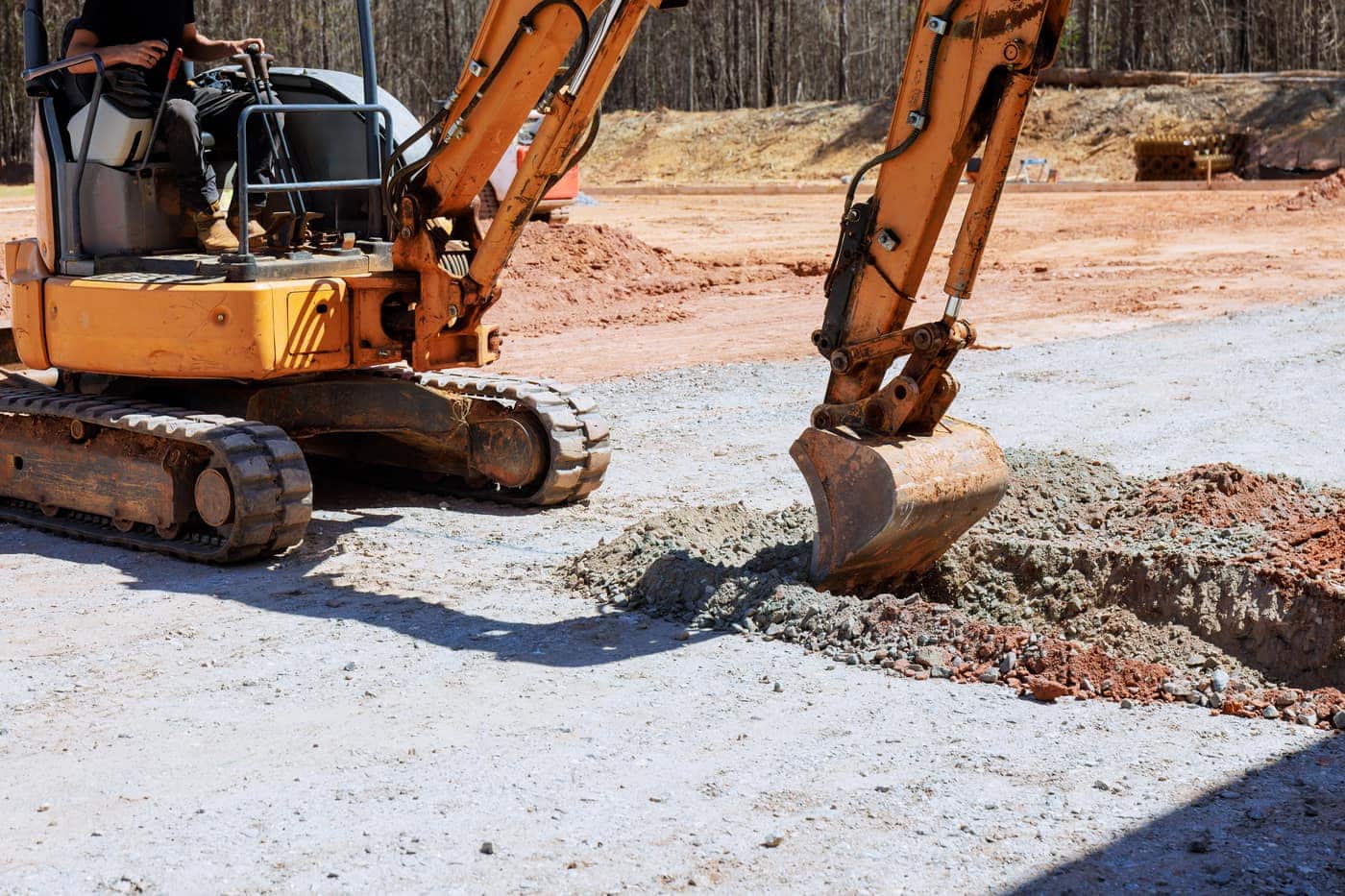
A Pennsylvania excavation business answers to a statute that tells the excavator to start with a locate request: “To submit a locate request to identify the location and type of facility owner lines at each work site by notifying the facility owner through the One Call System” (73 P. S. § 176 et. seq). The same reprint puts the duty on the person who does the digging, whether the work is for the owner or for a customer, and it sets a window for the notice. Workers’ comp is a separate duty, and the truck limits come from a motor vehicle FAQ.
Every quote below carries a link to the page it comes from, so you can read the sentence in its own setting. Where we have not confirmed a point, we say so and name the Pennsylvania office to ask. For the whole program across states, read our excavation insurance page; the rest here stays with Pennsylvania.
The locate request under the Underground Utility Line Protection Law
The Act is cited as “73 P. S. § 176 et. seq”, and the copy we link is a reprint hosted by the one-call center rather than by the legislature, so confirm the current wording with the center before you rely on it. The reprint defines the excavator in these words: “means any person who or which performs excavation or demolition work for himself or for another person” (reprint, definition of excavator). The words quoted name work done for himself or for another person.
The duty itself is stated as “To submit a locate request to identify the location and type of facility owner lines at each work site by notifying the facility owner through the One Call System” (reprint, excavator duties). The timing is stated in the Act’s own sentence: “Notification shall be not less than three nor more than ten business days in advance of beginning excavation or demolition work” (reprint, notification). Complex projects and emergencies are handled in neighboring sentences, which we do not quote; if your job is a long utility run, read those sentences in the Act before you schedule the crew.
The one-call center for Pennsylvania is Pennsylvania One Call System, Inc. dba Pennsylvania 811. We do not describe what the center does after a request is entered, how it passes the request to a facility owner, or what a facility owner must mark; the center can walk you through those steps. When you call, write down the date and the name of the person you spoke to.
Your confirmation of the request shows when you asked about the buried lines, and it may be worth keeping beside the policy papers. An underwriter reading an application and an adjuster reading a loss may each ask how your crews handle the call. We do not state that any policy requires proof of a request, or what a policy pays when a request was or was not made. Keep the confirmation in the job folder so it is there if anyone asks, and ask your agent whether the application has a place to describe how your crews call before they dig.
The Pennsylvania flow starts with the locate request entered through the center the Act names, moves to the dig, then to a possible strike and the claim file an insurer may read against the policy and the application. No figures are shown.
A struck line, a claim, and the application you signed
For a Pennsylvania excavator the dreaded call is a neighbor’s: a bucket has found a buried gas, water, electric or communications line, and the repair bill lands on your job. Other people lose service or have to leave while it is repaired. General liability may respond to a claim like that on its terms, and what is paid turns on the wording of the policy that was issued.
Three things on paper bear on that reading. The description of your work on the application comes up, because trench work, grading for pads, basement and foundation digging and site preparation are different jobs, and an application that leaves one out invites a question when the claim arrives. The limits on the policy and any endorsement that changes them come up as well. And the contract matters, since a contract may shift responsibility for the line, ask you to indemnify the owner, or name another party as an additional insured.
Pennsylvania’s statute ties the excavator’s duty to a locate request submitted through the one-call center, and it sets the timing in the sentence quoted above. We say nothing about how a missed request would be treated, or about fault between an excavator and a facility owner. Ask your agent how your policy reads for a strike on a marked line, and how it reads for a strike on a line that was never marked.
Notes you keep at the dig help the same folder. Write down the date of the locate request, who on the crew handled it, what the marks looked like when the machine arrived, and which machine and operator were on the job. We do not state that a policy asks for those notes. They are facts an agent or an adjuster may ask about, and they are easier to write down on the day than to rebuild a season later.
A machine damaged in the same strike raises a different question. Contractors equipment insurance may respond to damage to the machine on its terms, while general liability speaks to damage to others. Ask your agent which policy the wording points to for each part of a loss.
Excavation licensing in Pennsylvania: who to ask
We have not confirmed how Pennsylvania licenses excavation work, whether through a license, a registration or a board of its own. The state lists the Office of Attorney General for contractor licensing questions, and that is the office to call first about your basement and foundation jobs, your grading for building pads and your trench and utility work.
Permits are a second place to ask. The municipality or county office that issues the permit for a job site can say what it wants from you before the machine arrives, and we state nothing about what those offices require. If you work for a general contractor or a public owner, their bid documents may list what they expect, so read them with your agent.
Whatever you learn, tell your agent before the application is signed. A license or registration you hold is a fact about your business, and the application asks about the work you do, the kinds of customers you serve and the sites you work. Describe the digging in the application the same way you describe it in your contracts.
Workers’ comp: the duty to insure and the two gaps
Pennsylvania’s Act states the duty in one sentence: “Every employer liable under this act to pay compensation shall insure the payment of compensation in the State Workmen’s Insurance Fund, or in any insurance company, or mutual association or company, authorized to insure such liability in this Commonwealth, unless such employer shall be exempted by the department from such insurance” (Workmen’s Compensation Act). The Act makes the duty compulsory, and its wording names two places an employer may insure the payment of compensation: the State fund, or an authorized insurer. The Act also says the department may exempt an employer, and we do not say who qualifies.
Two points are not confirmed here. We have not confirmed an employee-count threshold for the duty, and we have not confirmed whether an owner or partner may elect to be included or left out. Ask the Department of Labor and Industry, which Pennsylvania lists for workers’ compensation, and ask your agent how the policy treats the owner and any officers before the audit rather than at it.
On a crew like yours, the work differs from seat to seat. The operator who runs the excavator, the laborer who hand-digs around a marked line and the driver who hauls fill may each be described differently on the application, and each is paid differently. Describe what each person does on a normal day and tell your agent when the mix changes during the year. Our workers’ compensation page explains how a policy is written and audited; we claim no Pennsylvania rule about how crews are classified.
The Act describes the State fund as a State-operated insurance carrier from which policies may be purchased, and an authorized insurer may write the coverage. We do not compare the fund with other insurers or say how an employer chooses; your agent and the Department of Labor and Industry are the places to ask.
The DMV’s insurance FAQ and your truck schedule
The auto limits we can quote come from the Pennsylvania DMV’s motor vehicle insurance law FAQ, which lists “$15,000 for injury or death of one person in an accident $30,000 for injury or death of more than one person in an accident $5,000 for damage to property of another person” (DMV insurance law FAQ). We do not restate the limits outside the quote. The FAQ speaks of registered motor vehicles, and a dump truck or a pickup on your schedule is one.
We have not confirmed a separate minimum for commercial vehicles that haul for a construction business. The Pennsylvania Insurance Department is the office Pennsylvania lists for insurance, so ask it. Do not assume the quoted limits are what your contracts want; read the contract.
A commercial auto schedule lists the vehicles that move the work: dump trucks, pickups, trailers for the machines, and any tractor that pulls a lowboy. Who may drive, whether employees run errands in their own vehicles, and whether trucks are hired for a job are questions for the application. A truck that leaves the state for a job raises those questions again, since we state no Pennsylvania rule for it. Ask your agent whether a machine on a trailer may respond under the equipment policy, the auto policy or both, on their terms.
A stack of labeled layers, top to bottom: Pennsylvania call-before-you-dig center; Pennsylvania Insurance Department; Department of Labor and Industry; Your agent, with each reply. No figures are shown.
The policies set beside Pennsylvania’s Act and the DMV’s FAQ
General Liability: damage to a neighbor’s property
General liability may respond on its terms when a machine strikes a line, when a trench undermines a neighbor’s wall, or when a graded pad sends water onto the next lot. The statute on locate requests is quoted above, and we state no Pennsylvania rule about what general liability pays for a strike. How the application describes your work, how your limits read and what your contracts say are the questions to take to your agent before the season.
Workers’ Compensation: the crew on the job
Workers’ compensation answers the duty quoted from the Act, to insure the payment of compensation. The threshold and the owner election are open points here. A program for the crew that runs the machines, hand-digs near lines and hauls the spoil can be written on its terms, and the Act’s quoted sentence names the State fund and an authorized insurer as the places to insure. Ask your agent how each job on your crew is described.
Commercial Auto Insurance: the trucks and trailers
Commercial auto sits beside the DMV limits quoted above, and the commercial-vehicle minimum is an open point. The schedule should list each dump truck, pickup and trailer, the people who drive them and any vehicles hired for a job. Ask how a truck loaded with fill, a lowboy carrying an excavator, and a pickup used by the foreman are each written, and what each policy says about the load it carries.
Contractors Equipment Insurance: machines on a schedule
Contractors equipment insurance may respond to damage to your excavators, loaders and attachments on its terms, and we state no Pennsylvania rule for it. Ask how each machine is described and valued, how the policy reads while the machine is on a trailer or parked at a site overnight, and what happens to a rented machine you run under a rental agreement.
Umbrella Insurance: limits above the underlying policies
Umbrella insurance sits above the underlying policies and may respond on its terms when a loss runs past their limits. We state no Pennsylvania rule for it. A contract may ask for higher limits than your general liability and auto carry, and an umbrella may be one way to reach them; ask your agent what the underlying policies must show for the umbrella to apply.
Property Insurance: the shop, the yard and what is in them
Property insurance speaks to the shop, the yard and the contents you own or lease, such as tools, parts and fuel tanks. We state no Pennsylvania rule for it. Ask what the policy treats as the building, what as contents and what as equipment, so that a loss is not argued between policies, and ask what happens when the shop is closed after a fire.
Once your counties, machines, trucks and payroll are written down, a quote request starts the conversation.
Pennsylvania offices to call, by name
Pennsylvania lists the Pennsylvania Insurance Department for insurance, the Pennsylvania One Call System, Inc. dba Pennsylvania 811 as the one-call center, the Office of Attorney General for contractor licensing questions, and the Department of Labor and Industry for workers’ compensation.
We state nothing about what each office decides beyond that role and the lines quoted above. When a question falls outside a quote, ask the office the question was written for, and keep the date, the name of the person who answered and the answer with the job or the policy it concerns.
Paper to have ready when a contract asks for proof of coverage
A contract on a Pennsylvania job may ask for a certificate of insurance that names the owner or the general contractor as an additional insured, and it may name limits, a waiver of subrogation or a hold-harmless clause. We state no Pennsylvania rule about what a public owner or a general contractor must ask for. Read each contract, because the contract is where the request is written.
Before you sign, match each requirement to a policy: the insured party and the limits to general liability and the umbrella, the crew’s proof of coverage to workers’ compensation, and the trucks to commercial auto. Ask your agent whether the certificate shows what the contract asks, and whether any wording in the contract goes beyond what the policy was written to do.
If a contract names a limit your policies do not reach, ask your agent whether an umbrella, a change to the underlying limits or an endorsement closes the gap on its terms, and what each would change on the application. Subcontractors you hire may carry their own policies, and a contract may ask you for their certificates; keep those in the job folder next to your own locate request.
Items to settle with your agent and the offices above
- Enter the locate request inside the window quoted above, and keep the confirmation in the job folder.
- Ask the Department of Labor and Industry about the employee-count threshold and the owner election, since both are open here.
- Ask the Pennsylvania Insurance Department which minimum applies to a commercial truck, since that is open here.
- Ask the Office of Attorney General, and the permit office where you dig, how excavation work is licensed.
- Describe each kind of dig on the application: trench, grading, basement and foundation, site preparation.
- Match each contract’s insurance clause to a policy before you sign it.
Where the rules are stated: the reprint, the Act and the FAQ
The one-call law is quoted from a reprint on the center’s own site, which is not the legislature’s copy, so confirm the wording with the center. The Workmen’s Compensation Act and the DMV’s FAQ are each linked beside the line quoted from them, and the Sources list below carries every page cited here.
Still open: how Pennsylvania licenses excavation work, the employee-count threshold for workers’ comp, the owner election, and the commercial-vehicle minimum. A line that reads as open is open, and not a statement that nothing applies. Ask the office named beside it.