
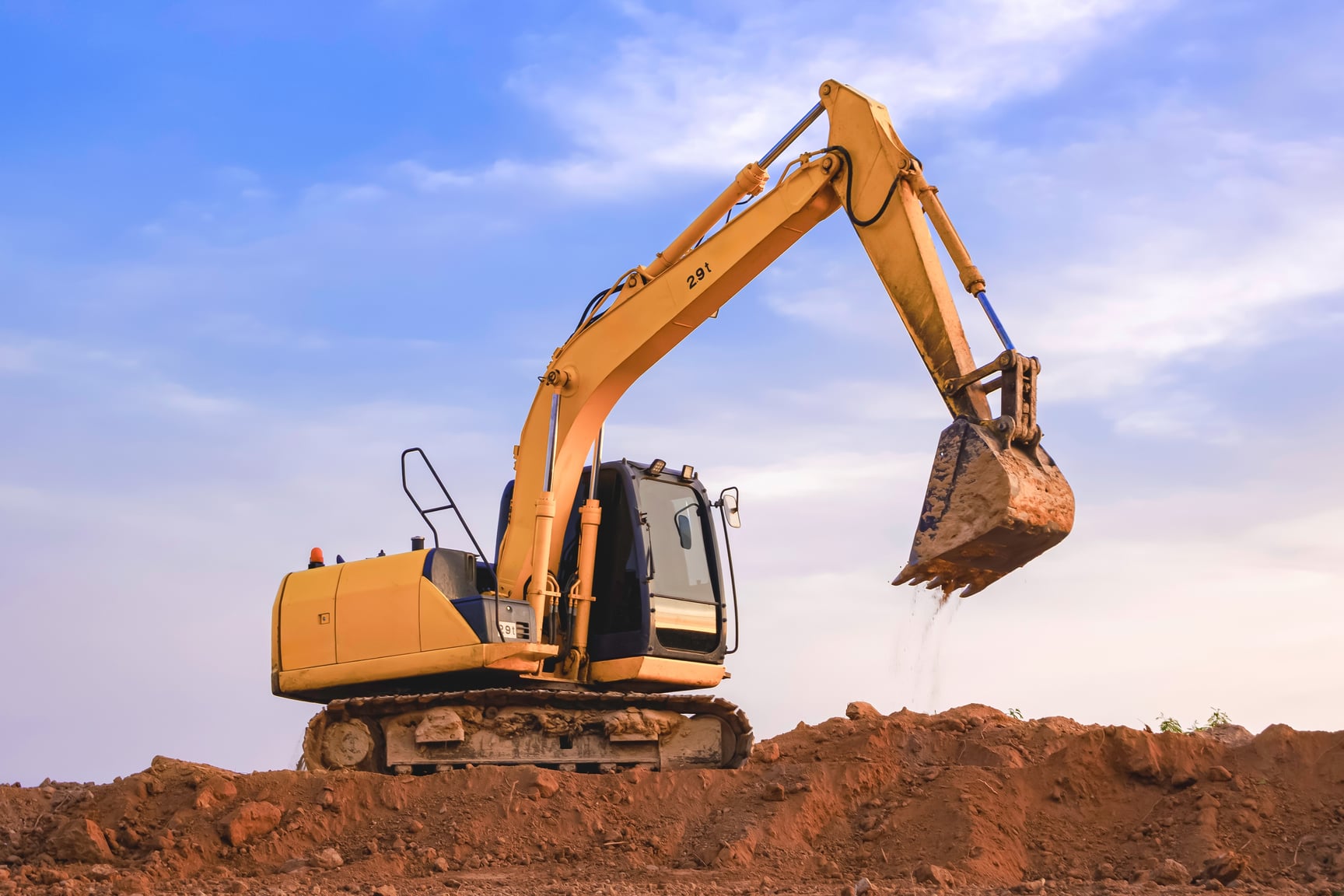
Excavation insurance is the set of policies an excavation contractor carries for the work of moving earth: liability for damage the work does to other people’s property, protection for the machines, coverage for the crew, the trucks and the shop, and an umbrella above them. It is not a single policy. It is a program built around what your crews dig, where they dig it and whom they dig it for.
If you own an excavation business, this is for you: the contractor who grades building pads and prepares sites, digs basements and foundations, cuts trenches for utilities, and sometimes takes down a structure or clears a lot ahead of the work. It follows the losses that kind of business brings, names the policy each is a question for, and points to the page where that policy is explained in full.
A morning on the pad, and a line nobody expected
Picture a crew finishing the cut for a building pad on a commercial lot. The marks are down, the operator is careful, and the plan shows the service lines where they were supposed to run. Late in the morning the bucket catches something the plan did not show: an old gas service, abandoned on paper and live in the ground. The crew shuts down, the site is cleared, the utility comes out, and by the afternoon the neighboring business has closed for the day.
Nobody was hurt. But by the end of the week the contractor has heard from the utility about the repair, from the business next door about the day it lost, and from the general contractor about the delay on the schedule. Each of them is asking the same question in a different way: which policy answers for this?
That question is why the program is put together the way it is. The damage to the line and the neighbor’s lost day are questions for general liability, and how that policy treats underground work depends on its wording. If the machine had slid into the cut, that would be a question for the equipment policy. If an operator had been hurt, it would be a question for workers’ compensation. A program read before the job, rather than after it, is the one where those answers are already known.
Your excavation business sits at the center of this picture. Around it are land grading, site preparation, utility and trench work, basement and foundation digging, and hydro excavation. Each line names the question that kind of work raises when the program is put together. Demolition and land clearing have their own pages. No figures are shown.
Land grading and building pads
Grading changes the shape of the ground and, with it, the way water leaves a property. A pad that is cut and filled correctly for the plan can still send runoff toward a neighbor’s yard, a road or a drainage ditch while the work is open. When mud, sediment or water damages property that is not yours, the first question is whether your general liability wording treats it as ordinary property damage or reads it under its pollution terms.
Grading work also leaves something behind: the finished surface others will build on. A pad that settles after the building goes up raises a question about completed work, which is a different part of the liability policy from damage done while the machines are on site. An application that describes the grading you do, the compaction you are responsible for and the plans you work from gives an underwriter the facts to answer both.
Site preparation
Site preparation puts your crew on a property before anyone else arrives, and leaves it ready for the trades that follow. The work runs from staking and access roads to topsoil stripping, spoil piles and erosion controls. Each of those touches something that belongs to someone else: the street the trucks cross, the curb the lowboy rolls over, the tree line at the edge of the lot, the fence along the property line.
On larger sites the contract may set out who is responsible for what, and it can ask you to name the owner or the general contractor on your liability policy. Read those terms before the bid is final. The endorsements a contract asks for are part of the insurance cost of the job, and an agent can tell you whether your current policy can carry them. Our guide on how to estimate excavation jobs shows where that cost sits in the number.
Site preparation is also where the trucks and the machines share the ground most closely. A dump truck backing to a spoil pile, a loader working beside the haul road, a lowboy unloading on a street shoulder: each is a moment where the auto policy, the equipment policy and the liability policy can all be asked the same question. Describe how your trucks and machines move on a site, and the program can be built so the answer is not left to argument.
Utility and trench work
Trench work puts the crew below grade and the bucket beside lines that are already in service. It is work where a struck utility is a real possibility, and where an injury in the cut is a serious concern. Those are two different questions. Damage to the line and to the property around it is a question for general liability. An injury to your own worker in the trench is a question for workers’ compensation.
Underwriters can ask how your crews handle locates, how they protect a trench and how they dig near marked lines. Rules on locate requests differ from state to state, and the state pages address them. A clear written practice for locates and trench protection is one of the facts that shapes how a trench account is read.
Basement and foundation digging
A basement dig opens a deep hole close to something meant to stay standing: the house next door, a shared wall, a sidewalk, a retaining wall at the property line. If the soil moves, a neighbor’s foundation can crack or settle. Damage to a structure you do not own is a question for general liability, and collapse and subsidence wording varies between policies, so that is the clause to read before you dig beside an occupied building.
Foundation work also brings heavy machines close to the edge of the cut. A machine that slides into an excavation is damage to your own equipment, which is a question for contractors equipment insurance; liability is written for harm to others, and its wording shows how it treats your own machines. Keep those two questions separate when you describe the work, and the program will be built to answer both.
Hydro excavation
Some excavation contractors expose buried lines with water and a vacuum truck before any bucket goes in the ground. The method can be chosen because it is gentler on utilities, but it brings its own questions: a specialized truck that is both a vehicle and a piece of equipment, a slurry that has to be hauled and disposed of, and work done in tight spaces beside lines that are live.
List hydro excavation as its own line of work on an application. The truck may need to be described for both the auto and the equipment policies, and the disposal of what it collects raises a question about pollution wording. A program that knows the method is part of your work is one an underwriter can rate correctly.
Hydro excavation can be hired by other contractors to expose lines before they dig. When that is your work, the contracts you sign may ask you to stand behind the location of what you exposed. Read those terms with your agent, because a promise made in a contract is not always a loss your liability policy was written to carry.
When the job includes demolition
Some excavation contractors take down a garage, a shed or a small building before the dig can start, or remove a slab and haul the debris. Demolition raises questions excavation does not: damage to the parts of a structure that are meant to stay, what is found inside an older building, and the dust and debris that leave the site. Describe it on your application. Demolition is also a trade of its own, and the page on insurance for demolition contractors is written for those businesses.
When the job starts with land clearing
Before a site can be graded it may have to be cleared: brush cut, stumps pulled, roots grubbed and the material mulched or hauled. When your excavation crew does that clearing with your machines ahead of your own grading, describe it on your application. Land clearing is also a business of its own, and the page on insurance for land clearing businesses is written for those companies.
This flow follows an excavation program from the first conversation to the quote. You describe the work you do and the work you turn down. The machines and trucks are listed. The crew is sorted by the roles they fill. The contracts you sign are read for what they ask of your insurance. The program is then quoted and compared. No figures are shown.
Putting the application together
An excavation application is a description of a business. The clearer the description, the fewer assumptions an underwriter may make, and the fewer surprises there may be when a claim is filed. Start with the work: the kinds of digging you do, how deep, near what, for whom. Then name the work you turn down, because that can tell an underwriter as much as the work you take.
List the machines and trucks, owned, leased and rented, and how each moves between jobs. Sort the crew by role, because an operator, a laborer in the trench, a driver and an office worker are rated differently. Gather the contracts you sign regularly, with the insurance pages marked. Your current declarations pages and your loss history round out the picture.
Contracts and certificates
General contractors and project owners may ask excavation subcontractors for certificates, additional insured endorsements and sometimes waivers of subrogation. The endorsements and waivers are changes to your policy; a certificate only reports what the policy already says. Before you sign, send the insurance section of the contract to your agent so the endorsements it asks for can be checked against the policy you carry.
When the business changes mid-term
Tell your agent when the work changes: a new kind of job, a new state, a machine bought or sold, a truck added to the fleet, a new driver, a contract with heavier insurance terms. Changes reported during the term are simpler to handle than changes discovered at an audit or after a loss.
Read each row from left to right. A struck buried line or damage to a neighboring structure is a question for general liability. A machine that tips, burns or is stolen is a question for contractors equipment insurance. The shop and the yard buildings are a question for property insurance. An injury to your own crew is a question for workers’ compensation. A crash involving a dump truck or crew pickup is a question for commercial auto. A claim that runs past those policies is a question for umbrella insurance. How each policy answers depends on its terms. No figures are shown.
How the policies fit together
Each policy in an excavation program answers a different kind of loss, and each has a page of its own. The program is read as a whole because the gaps between policies are where claims can go unanswered.
- General liability is written for damage your work does to someone else’s property and injuries to people outside your payroll, including struck lines and damage next door, on the terms of its wording.
- Contractors equipment insurance is written for your machines on a schedule, on the terms of its wording.
- Property insurance is written for the shop, the yard buildings and what is kept inside them, on the terms of its wording.
- Workers’ compensation is written for injuries to your own crew, with premium sorted by job class, on the terms of its wording.
- Commercial auto insurance is written for the trucks that haul spoil and the rig that pulls the lowboy, on the terms of its wording.
- Umbrella insurance adds liability limit above the policies beneath it, on its own terms.
The same loss can touch more than one of them. A truck that backs into a trench can raise auto, equipment and liability questions at once. Reading the program together is how you learn, before a loss, which policy is expected to answer.
After the crew leaves the site
An excavation job does not end when the machines are loaded. The pad you graded carries a building. The trench you backfilled carries a road. The foundation hole you dug becomes a basement someone lives above. When finished work settles, cracks or fails months later, the claim that follows is a question about completed work, and it is read differently from damage done while the crew was on site.
Ask how your liability policy treats completed work, how long after a job a claim can be brought under it, and whether your contracts ask you to keep that protection in place for a period after the job ends. Keep your records: compaction reports, inspection sign-offs, photographs of the open cut before backfill. They are the evidence of what you left behind, and they may matter to an underwriter reading your account as much as to an adjuster reading a claim.
Rules that change at the state line
Excavation is regulated in layers. Digging near buried utilities, workers’ compensation, vehicle insurance and contractor registration are set state by state, and some jobs bring local permits as well. Those rules are not listed here. The states we serve section covers them state by state, and an agent can tell you which apply to the work you do. The state pages include New York, Indiana, Ohio, Colorado, Missouri, Texas, Michigan, California, Florida, Mississippi, Massachusetts and Pennsylvania, and all states we serve are listed together.
Why Excavating Business Insurance
We build excavation programs from the work outward, and our homepage shows that order on one page. Before a submission goes to market we ask what your crews dig, near what, and under whose contract, and we read the quotes that come back for the wording that matters on a dig: underground and collapse terms, the equipment schedule, the job classes and the endorsements your contracts call for. The differences in wording are laid out for you before price enters the comparison, and you keep a licensed agent for the changes that come during the year.