
Indiana’s locate ticket and the Bureau of Motor Vehicles’ liability standards are the two rules quoted here. The Indiana Utility Regulatory Commission says “Requesting a locate ticket is the first step to take before an excavation or demolition” (agency page). Licensing, workers’ comp for your crew and a commercial truck minimum are open questions below, each with the office to ask.
Next step for an Indiana owner: pull your contracts, your machine list and your payroll, then read what follows beside the excavation insurance overview and the quote form at the end.
Indiana’s locate ticket, as the Utility Regulatory Commission words it
The Commission points to “investigating alleged violations of Indiana's 811 law ( Indiana Code chapter 8-1-26 )” as the state’s call-before-you-dig law (Indiana Utility Regulatory Commission). Its page says “Requesting a locate ticket is the first step to take before an excavation or demolition” (same page), and also “utilities with underground facilities will mark the lines within two full working days” (same page). It names the center this way: “You can request a locate by contacting Indiana 811” (same page). The center posts its own text of the law at its website.
Who must make the call, the excavator, the property owner or someone else, is unsettled on this page. Put it to the Indiana Utility Regulatory Commission, whose Pipeline Safety Division investigates alleged violations of the law, and read the center’s posted text before you assign the call to your operator or your customer.
Keep each ticket: its number, the date and the marks on the ground, with photographs. An underwriter or an adjuster may ask what your crew knew before the bucket went in, and an application may ask how your crews request locates and what they do when marks are missing.
The flow runs from the request to the center, to the marks, to the dig, and on to a possible claim. Each stop is a place where a written note of what your crew knew may matter later. No figures are shown.
A ruptured service line and the Indiana claim file
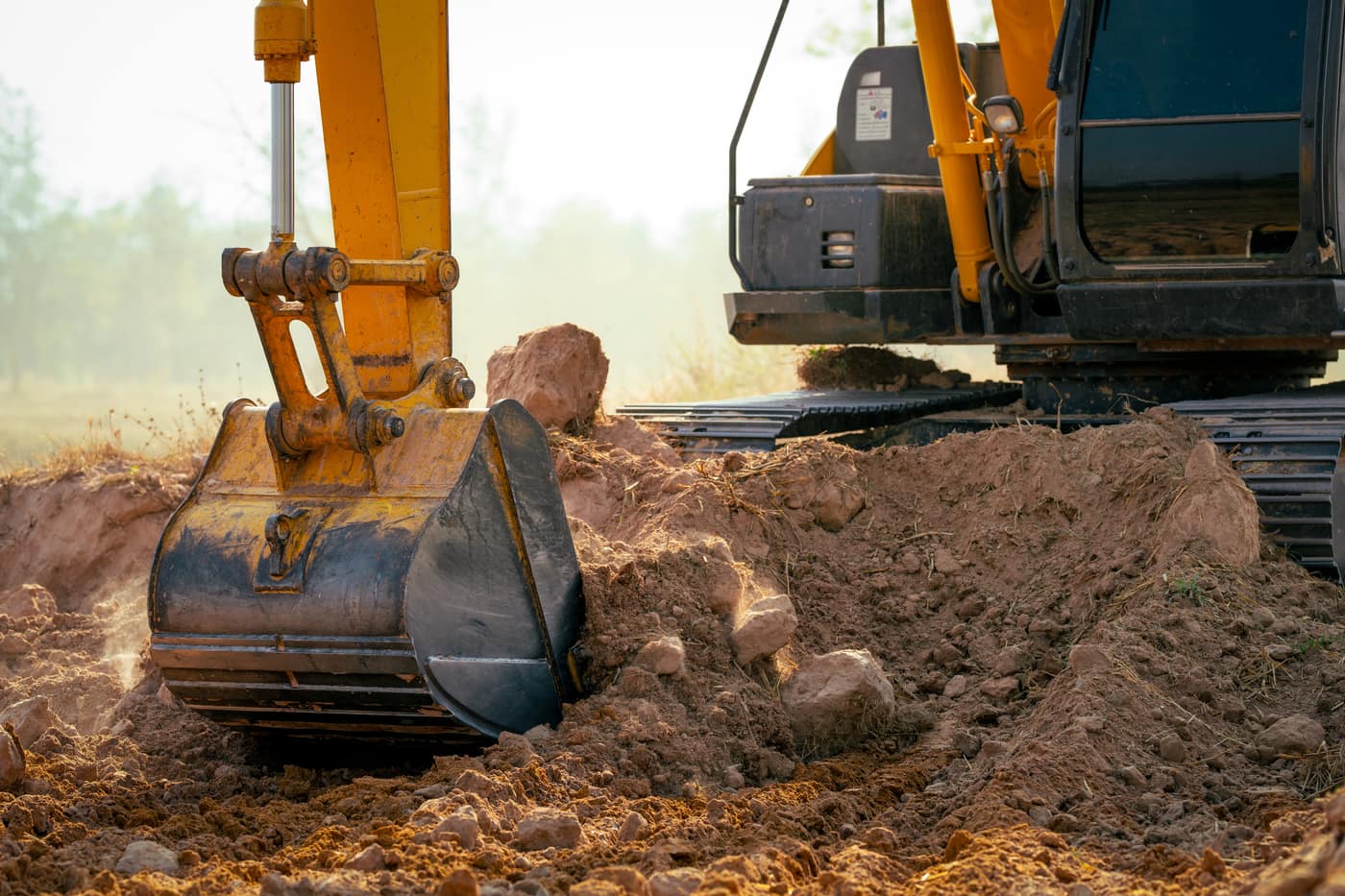
Picture the bucket tooth through a gas service, a water main, a fiber duct or a neighbor’s foundation wall. What gets paid, and up to what amount, turns on the policy’s wording: the limits you bought, the way you described the job when you applied and what the customer’s contract demands. A policy may respond on its terms; ask your agent how it reads.
Damage to your own machine is a different question from damage to someone else’s property, and so is restoring service to a utility’s customers. Ask which policy may respond to each piece and whether a condition in the wording speaks to underground utilities. The general liability page goes through these questions.
Excavation licensing for Indiana work: who can tell you
Whether Indiana or a county licenses excavation work is something we have not pinned down. Read the bid documents for credentials the customer wants, and ask the local government department that issues permits for the site what it wants to see before a machine starts.
If a license or registration does apply to the work you bid, expect the insurance application to ask about it. The Indiana Department of Insurance is the insurance regulator; it is not named here for licensing.
Workers’ comp in Indiana: the Board’s name, and an unanswered duty
How Indiana’s workers’ compensation law treats an excavation crew, from the regime to a headcount threshold to owner coverage to who writes the policy, is unsettled on this page. The Worker’s Compensation Board of Indiana is the workers’ compensation regulator; ask it how coverage works for a business with your payroll.
Your agent will want payroll sorted by job class and any subcontractor’s certificate, so gather them before the call. The workers’ compensation insurance page covers the policy and its audit.
Indiana haul trucks and the BMV’s printed liability standards
The Bureau of Motor Vehicles prints its state minimum liability standards this way:
“$25,000 for bodily injury to, or the death of, one individual; $50,000 for bodily injury to, or death of, two or more people in any one accident; and $25,000 for property damages in any one accident” (Indiana Bureau of Motor Vehicles)That is the Bureau’s page, not the statute text. For a dump truck or tractor, ask your agent which minimum applies, and read any limit a contract names, which may sit above a state floor.
A commercial auto schedule lists each truck, trailer and pickup, its driver, where it is garaged and what it hauls. If a foreman drives a personal pickup on company errands, put that question to your agent. The commercial auto insurance page has the longer treatment.
A stack of labeled layers, top to bottom: Indiana call-before-you-dig center; Indiana Utility Regulatory Commission; Worker’s Compensation Board of Indiana; Indiana Department of Insurance; Your agent, with each reply. No figures are shown.
Where each Indiana policy question lands
General Liability
Think of the machine at the edge of a cut. A bucket tooth finds a gas service, a neighbor’s footing settles after a trench opens beside it, or runoff from a graded pad reaches the next lot. General liability may respond to claims like these from people outside your business, on its terms. The application’s description of your work shapes how it is rated, so describe the trenching, the grading and the hauling as they are. The locate ticket reaches this policy through the application, which may ask how your crews request marks. Your agent can show how the wording treats underground utilities.
Workers’ Compensation
The people closest to the work are the operator in the cab, the laborer in the trench and the driver at the pit. Workers’ compensation is the policy built around injuries to employees like these, and the Indiana duty is an open question above for the Board to answer. A program for the crew may still be written on its terms. Payroll sorted by job class drives the application, and the premium audit at the end of the term compares what you estimated with what you paid. Bring subcontractor certificates so the audit has them in hand.
Commercial Auto Insurance
Dump trucks haul spoil away from a basement dig, a lowboy carries the excavator to the next site and a service pickup follows with fuel and teeth. Each rides on a commercial auto schedule with its driver and garaging address. The Bureau’s printed standards sit above, and a commercial-vehicle minimum is something to settle with your agent. Mud tracked onto a public road, a driver you hire for the season and a rented truck are all questions to put to the agent before the truck leaves the yard.
Contractors Equipment Insurance
Excavators, dozers, skid steers and the trailers that move them are the capital of a dirt business. A scheduled equipment policy may respond to damage to a machine itself, on its terms, whether it sits on a pad in Indianapolis or rides a lowboy to a site near Bloomington. List each machine with its value and say where it is kept overnight. Rented machines and attachments, such as a hydro vacuum unit or a hydraulic hammer, are a question for the agent. Indiana adds nothing here beyond what the contract asks.
Umbrella Insurance
A struck transmission line or a collapsed trench wall can produce a loss larger than the underlying liability limit. An umbrella may respond above underlying liability and auto limits where a loss exceeds them, on its terms. An owner’s first look at it may come when a general contractor writes a higher limit into a contract. Ask your agent which underlying policies the umbrella sits over and what it requires of them, so the limits line up before the bid goes out. Nothing in Indiana’s published rules above speaks to it.
Property Insurance
The yard is where a dirt business keeps its parts, fuel and tools. Property insurance may be written for the shop, the equipment shed and what is inside them, on its terms. A storm that takes a roof or a fire that closes the shop raises questions about the building, the contents and the days the crew cannot work. Ask your agent how machines parked in the yard are treated, since an equipment policy may be the one that answers for them. Nothing in the Indiana sources above speaks to it.
To have these written together, use the quote request.
Indianapolis site prep to Fort Wayne hydro work: six kinds of dirt work
An application asks what you dig and how. These are the six kinds of work an excavation business may describe, each in the words an underwriter may read.
General excavation
Opening ground for a customer who needs it opened: a pit, a pond, a cut for a drive. Say the depth you work to, the soil you meet and who hires you.
Land grading and building pads
Shaping a lot so water leaves it and a building can sit on it. Site grading in Indiana is rated on the machines used and on what sits next to the pad, so mention the neighbors and the drainage.
Site preparation
Stripping, cutting and filling before the builders arrive. An application may ask whether you also haul and what you do with the spoil.
Utility and trench work
Opening ground for pipe, cable and conduit, beside lines already in the ground. The locate ticket weighs heavily here, so describe how your crews request marks.
Basement and foundation digging
Digging for a house or building footing, close to a lot line and a neighbor’s wall. Say whether the neighbor’s property is within reach of the cut.
Hydro excavation
Opening ground with pressurized water and a vacuum, to see what is buried without a bucket. A hydro unit is its own piece of equipment, so list it on the schedule.
What an insurance application asks an Indiana excavation contractor
Expect questions on the kinds of work above, the machines you own or rent, the subcontractors you hire, the hauling you do and the sites you work. Underwriters may also ask about the customers: homeowners, builders, utilities or public owners. Answer in the same words you use on a bid, since the application becomes part of the policy’s terms. A contractor insurance request in Indiana reads best when it lists the work, the equipment and the payroll together. Construction insurance and general contractor insurance both start with the same list. Ask your agent what to add for a new line of work before you take the job, and whether a bid in another county changes the picture. Keep a copy of each application you submit, so the description of your work stays consistent from one renewal to the next.
Three Indiana bodies and what each is named for
The Indiana Utility Regulatory Commission is the one-call regulator, the Worker’s Compensation Board of Indiana is the workers’ compensation regulator and the Indiana Department of Insurance is the insurance regulator. Ask each about its own role. The Bureau of Motor Vehicles page supplies the liability standards quoted above.
Certificates, subcontractors and starting an Indiana excavation business
An owner or a general contractor may attach insurance wording to a contract: certificates, additional insured language, limits. Indiana law on what a certificate must show is not stated here, so send the contract itself to your agent and have each policy matched to it.
When you hire a subcontractor to open a trench or haul spoil, ask for that business’s own certificate before the work starts, and keep it with the job papers. A new excavation company in Indiana has no loss history to show, so be ready to describe your experience, your machines and your crew in plain words. Lafayette, Indianapolis and Fishers owners all start the same way: the work list, the equipment list and the contracts. The first contract may name limits you do not yet carry, so ask your agent about it before you sign.
Four gaps, four people to ask
Who must call: the Indiana Utility Regulatory Commission. The workers’ comp duty: the Worker’s Compensation Board of Indiana. Licensing: the permit-issuing department for the site and your bid documents. Truck minimums: your agent. Each answer you collect makes the application more accurate.