
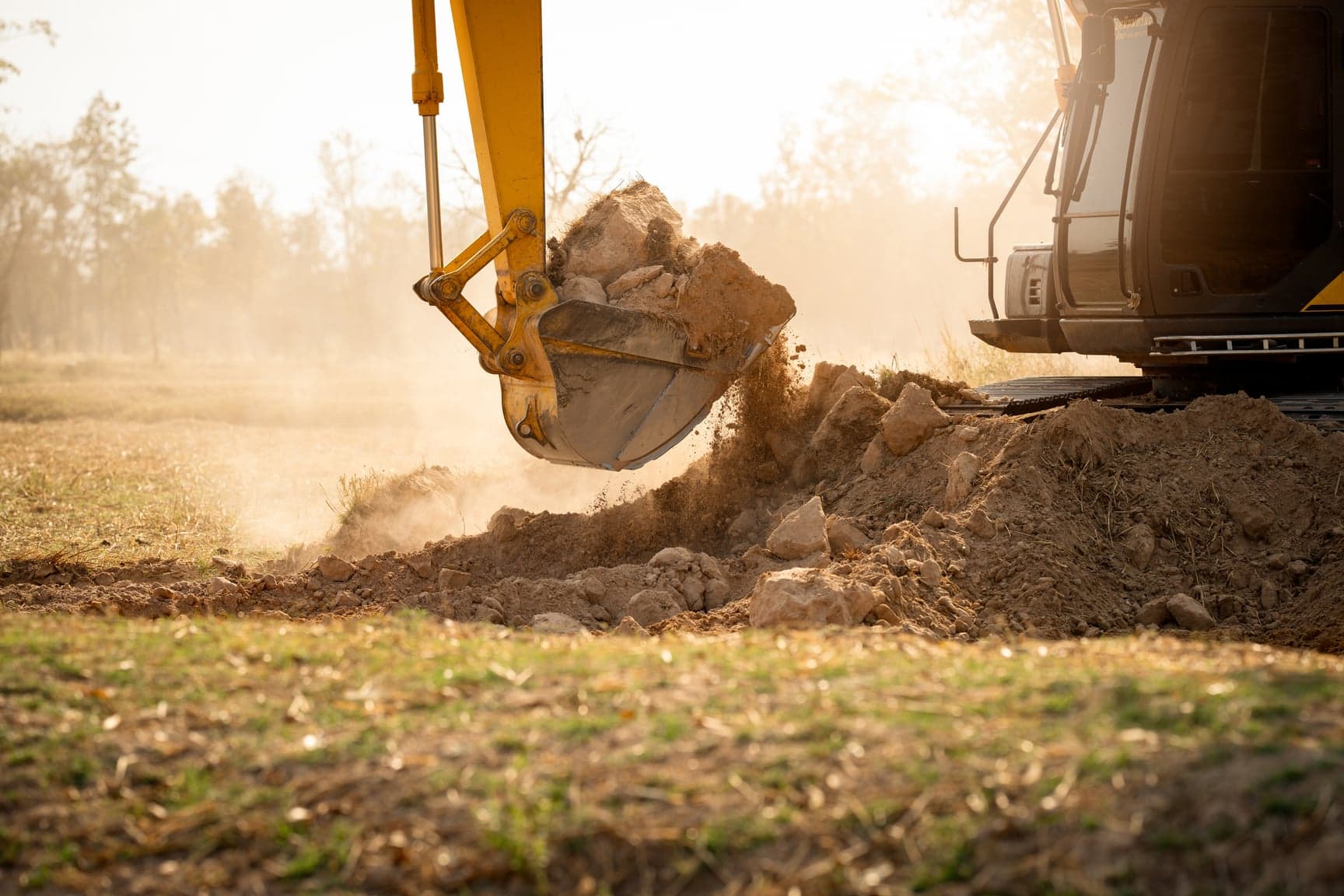
Montana puts the call on the excavator, and the code says what the call is for: “Before beginning an excavation, the excavator shall notify, through a notification center, all owners of underground facilities in the area of the proposed excavation” (Montana Code, duty to notify). For your crew that means a notice before the bucket goes in, a clear answer on who files it, and a written note afterward. Workers’ compensation reaches an employer with any employee, in the statute’s own words below, and contractor licensing for digging is a question for the Department of Labor & Industry Services.
Start with the notification and compensation sections below, then gather your contracts, your machine list and your truck list for a talk about excavation insurance built around Montana work. The open questions are marked as they come, each with the office that can answer it.
The Montana notification center and the excavator the code defines
The section that sets the call is headed “69-4-503 . Notification -- locating and marking” (Montana Code, notification section). Its duty sentence sits at the top of this page. Two more parts of the same law shape how your office runs a job, the definition of the excavator and the time window for a notice.
On who must make the call, the definitions section says “‘Excavator’ means a person conducting the excavation activities defined in subsection (12)” (Montana Code, definitions). Read it before you assume the notice belongs to someone else. If you hire out the digging, ask the notification center how a hired digger is treated, and put the answer in your subcontract so the foreman and the office read the same sentence.
On timing, the notification section limits a notice to a work window: “notifications are limited to excavation work intended to commence within 10 days and completed within 30 days of the notification” (Montana Code, notice window). If a job could start later or run past that window, ask the center what a fresh notice involves before the machine moves, and ask the owner or general contractor whose contract you signed what they expect from you.
The statute describes a notification center in general terms and does not tie the duty to one brand name. The center’s own site prints its name as Montana811, at https://www.montana811.org/, and that is the place to ask how a notice is filed and how a ticket is read.
Keep a dated written note of every notice: who filed it, the day, the job address, the work described and what the center told you. When an agent or an adjuster later asks whether the dig followed the notification rules, that note may answer in a minute what memory answers badly. Staple it to the job folder, not to the foreman’s phone, so it survives a change of crew boss.
The flow begins with the excavator contacting the notification center, moves to the work on the ground, then to a damaged underground facility, and ends where an adjuster may read the application, the limits, the contract and the notice note. No figures are shown.
A ruptured line on Montana ground: the paperwork behind a claim
A buried line that a machine ruptures can send several bills to one door: the owner of the line, a neighbor who lost service, a building owner with a damaged wall or footing. For an excavation business that is the claim the whole program is arranged around, and it is why the call to the center and the note of that call matter.
The liability policy may respond on its terms, and the terms are what an adjuster may read. Four things come up each time. The first is the description of your work on the application, because a policy written for one kind of dirt work is read against the job that actually happened. The second is the limit on the policy. The third is the contract, since an indemnity clause or an insurance article in a subcontract may add duties the policy does not mirror. The fourth is the notice paper from the center.
Do not wait for a strike to learn how the policy reads. Ask your agent, before a job starts, how the policy treats damage to underground property and what it says about the work you perform. Ask whether the work is described as general excavation, utility trench, grading or foundation work, because the description on the application is the first thing a claim is held up against.
After a rupture, stop the machine, make the site safe, and report the strike to the utility and to your agent the same day. Photograph the cut, the markings and the surface, and write down what the operator saw. Do not guess at fault in writing; leave that to the adjuster. Then pull the notice note, the contract and the application together in one place.
Contractor Registration Search at the Department of Labor & Industry Services
Montana’s Department runs a contractor lookup. The Department of Labor & Industry Services site lists a “Contractor Registration Search” (Department of Labor & Industry Services), under the name Contractor Registration. That is a registration for general contracting, and it is not stated to reach excavation work.
Whether Montana licenses or registers an excavation contractor as such is unconfirmed. The Department of Labor & Industry Services runs that lookup and is the body to ask, and the permitting office for the county or city where the job sits can say what it requires on the ground. Ask the same question of any general contractor or owner who hires you, since their bid documents may set their own conditions.
Put the answer in writing in your job folder. An application for coverage asks how the business is organized and what work it performs, and a clear answer about registration keeps that part of the paperwork tidy.
The Montana Workers’ Compensation Act and the plan an employer elects
The Act’s liability section says “the Workers' Compensation Act applies to all employers and to all employees. An employer who has any employee in service under any appointment or contract of hire, expressed or implied, oral or written, shall elect to be bound by the provisions of compensation plan No. 1, 2, or 3” (Montana Code, liability section). Read plainly, a Montana excavation business with any employee is inside that sentence, whether the person runs the machine, drives the truck, rakes the grade or works the trench box.
The sentence tells you the employer elects a plan; it does not tell you whether a larger payroll brings an extra rule. Whether the Act sets any further test beyond that sentence is unconfirmed, and the Department of Labor & Industry Services is the office to ask.
Owners ask about themselves next. The same section lists exemptions, and one item reads “employment of sole proprietors, working members of a partnership, working members of a limited liability partnership, or working members of a member-managed limited liability company, except as provided in subsection (3)” (Montana Code, exemption list). That is one list item read alone. The statute has a separate subsection on electing coverage, and what it means for a sole proprietor, a partner or a member of a member-managed company who runs the machine is a question for the Department.
We have not confirmed who may write an employer’s coverage under the plan choice, or whether a state fund is involved. Ask the Department before you assume either way. Meanwhile, the payroll description on an application should match the crew you actually run, with the operator, the laborer and the driver each described honestly.
Montana’s per-person auto limit and the commercial gap
For the trucks, the statute prints a bodily-injury minimum per person, in this sentence:
“(i) $25,000 because of bodily injury to or death of one person in any one accident and subject to the limit for one person” (Montana Code, financial responsibility)
Further limits follow in that subsection; the item above is the per-person one. A separate minimum for commercial vehicles is unconfirmed, so ask the Montana Commissioner of Securities and Insurance and your agent whether one applies to your trucks.
A commercial auto schedule for an excavation firm lists each tandem, tri-axle and dump truck, each pickup that tows a trailer to a site, and each trailer that hauls a machine. It names the drivers and the place the vehicles are kept, and it describes the hauling: how far, how frequently, for whom. A hauler who gives the application a short description invites a claim that argues about the long one.
A stack of labeled layers, top to bottom: Montana call-before-you-dig center; Montana Commissioner of Securities and Insurance; Department of Labor & Industry Services; Your agent, with each reply. No figures are shown.
Coverages for a Montana dirt contractor, and the Montana rule beside each
General Liability
This is the policy aimed at the claim in the middle of the page: damage to someone else’s property or person from your work, including a buried line a machine ruptures. Whether it responds is a matter of its wording: the work described, the limits and the contract. Montana’s rule that the excavator calls the center before digging sits right beside it, so keep the notice note in the job folder. Ask your agent how the policy reads for utility, trench, grading and foundation work.
Workers’ Compensation
Montana’s Act reaches an employer with any employee, and the employer elects a plan. For an excavation crew the policy follows the people on the machines, in the trench and behind the wheel, so the payroll description matters. Whether the owner is on or off the policy is the open exemption question above. How the plan choice and the insurer side work in Montana is unconfirmed, so ask the Department of Labor & Industry Services and bring its answer to the table.
Commercial Auto Insurance
Dump trucks, haul tractors, pickups and trailers belong on a commercial schedule, with the drivers named and the hauling described. The statute prints a bodily-injury minimum per person, quoted above, and the commercial-vehicle minimum is unconfirmed. Ask your agent how the schedule should be built, and ask the Commissioner of Securities and Insurance about the open question.
Contractors Equipment Insurance
An excavator, a loader, a skid steer, a compactor or a trench box is a machine that can be damaged in a rollover, stolen from a yard or lost in a transport accident. A schedule lists each unit with its description. The policy answers to its terms, and we have not tied a Montana rule to it, so the question for your agent is how a unit is valued, where it must be kept and what happens while it sits on a lowboy.
Umbrella Insurance
Umbrella limits sit above liability and auto, and they matter when a cut main, a failed trench wall or a loaded truck produces a claim larger than the underlying limit. The umbrella follows the underlying policies on its terms, and an owner of a Montana excavation business can ask an agent which underlying coverages it expects to see, and which exclusions it carries for the work you do.
Property Insurance
The shop, the yard building, the tools, the parts stock and the office contents are what this policy is about, not the machines out on open ground. We have not tied a Montana rule to it, so the questions are plain ones for your agent: what is described, where it sits, how a loss is valued, and what a freeze or a fire in the yard would leave to sort out.
When you are ready to see these set beside your Montana work, use the quote request and tell us the jobs, the machines, the trucks and the payroll.
Three Montana offices to ring before you guess
The Montana Commissioner of Securities and Insurance is the Montana office listed for insurance (csimt.gov). The Department of Labor & Industry Services is listed for workers’ compensation and runs the contractor registration lookup (Department site). The notification center prints its name as Montana811 (center website).
Match the question to the office. A dig question goes to the center; a compensation or registration question goes to the Department; an insurance question goes to the Commissioner. Ask each one what it handles before you send paper, and keep a note of whom you asked and what they said.
Contract language that follows a Montana excavation subcontract
A general contractor or a public owner may attach an insurance article to a subcontract. Read it for the limits it names, the policies it lists, whether it asks you to be named as an additional insured or to name the owner, and whether it asks for a waiver of rights against someone else. Each of those changes what your policy has to say.
Where a certificate is asked for, the agent issues it, and it shows what the policy says on the day it is issued. It is not a copy of the policy. If a job asks for something the policy does not give, an endorsement may be requested, and the agent can say whether the insurer is willing.
Subcontracts may also push the notice duty down to you. Compare that clause with the definition of the excavator quoted above, and ask the owner or general contractor who actually files the notice on each job, then write it into the contract so no one argues about it after a strike.
The six kinds of dirt work a Montana application may name
General excavation
Open digging with a hoe or excavator, moving soil from one place to another. An application describes it as the machine, the depth and the setting, and an underwriter may ask who the customers are and what they are building.
Land grading and building pads
Shaping a site so water drains and a building can sit level. The application asks about slopes, haul-off and whether the pad serves a private owner or a developer.
Site preparation
Stripping, stockpiling and rough-shaping ahead of other trades. Describe who follows you on the site, since the claim may follow them too.
Utility and trench work
Laying water, sewer, gas, power and communications lines in the ground. This is where the notification duty and the struck-line claim sit closest, and an application may ask which of those lines you install and who owns them.
Basement and foundation digging
Cutting a hole for a structure next to a neighbor’s wall or a street. The application asks about shoring, adjoining property and how close the cut runs to it.
Hydro excavation
Washing soil away with pressurized water and drawing it into a tank, so a buried pipe is exposed without a bucket. Describe it as its own line of work, since the rig and the exposure differ from a hoe.
What an application may ask before an insurer prices Montana excavation
An application gives the insurer the picture. It may ask what work you perform, what machines you run, whether you hire subcontractors and under what contracts, what you haul and for whom, and what kinds of sites you work. Be consistent across the forms: the work on the liability application should match the work on the compensation payroll description and the truck schedule.
If you subcontract the digging, say so, and say what proof of insurance you collect from the sub. If a subcontractor works under your name, the application should say that too. Honest answers made early are easier to defend than corrections made after a strike.
For a new excavation business, begin with the work you plan to do, the first machines and the first customers. An agent can build from there, and a new firm may ask the Department how registration and compensation duties apply before the first job is bid.
A checklist for the Montana office and the truck yard
- Ask Montana811 how a notice is filed and how long it holds for your job.
- Write down who files the notice on each job, and keep the note.
- Ask the Department of Labor & Industry Services about excavation licensing and the owner-election item.
- List every truck, trailer and driver for the commercial auto schedule.
- List every machine with its description for the equipment schedule.
- Collect the insurance articles from the contracts you have signed.
Where the Montana citations lead, and what stays open
The links above lead to the Montana legislature’s code site, the notification center’s website and the two state offices named. Still open are excavation licensing, the workers’ compensation insurer side and any further test beyond the liability sentence, and the commercial-vehicle auto minimum. Each has an office named beside it, so ask there and send us the answer.