
Nationwide, a small excavating business pays around $500–$1,200+/yr for general liability, and a full program for a contractor that has grown runs above $2,000–$7,000+/yr, figures Nate Jones, CPCU, has verified from the agency’s own experience. On a bid, general liability and workers’ compensation can be requested as a pair because they answer for different losses.
Each policy’s own wording decides what it answers for, so this is a guide to reading the request rather than a promise about a claim. For the whole program, see excavation insurance.
Why a bid package asks for the pair together
A general contractor may ask for the pair because a dig can hurt people and property in more than a single direction. The liability line is written for claims about what your work does to others, on its terms. The compensation line can show that your own injured worker has somewhere to turn, depending on the state’s rules. Asking for either alone can leave part of the question open.
The party asking may be protecting itself first. If your crew breaks a service line and you carry no liability policy, the claim can travel up the chain of contracts. If your laborer is hurt and you carry no workers’ compensation, that claim can travel too. An exhibit can be a way to settle both before the work begins.
Seen that way, the request is not a formality. It can be read as a description of two losses somebody else would like to keep off their own books, and reading it like that makes the odd phrases easier to follow.
What the general liability line is asking for
The general liability line asks whether your policy is written for damage your work does to other people and their property, at limits the contract names. On excavation work the questions underneath are specific: does the policy limit underground damage, how does it treat collapse, does it speak to explosion, and is the kind of digging on this job within the operations it describes.
Those answers sit in the policy, not on the certificate. A company whose declarations say grading and whose bid says deep trenching has a mismatch to fix before anyone signs. The general liability page lists the wording to raise by name, and it is written for owners rather than lawyers.
Completed work is part of the same line. An exhibit may ask that the protection it wants continue after the crew has left, because a pad or a trench can cause damage later. Ask whether the additional insured endorsement on your policy reaches finished work, since some versions stop when the job does.
What the workers’ compensation line is asking for
The workers’ compensation line asks whether your own people are insured for injuries on the job, under the system of the state where they work. It can also ask for employer’s liability limits, which belong to the second part of the same policy. Neither part says anything about the property you might damage.
The workers’ compensation page explains how operators, laborers and drivers are told apart on a dig crew. An exhibit may not ask to see that sort. It matters anyway, because a policy built on the wrong description can produce a bill, or a dispute, long after the bid was won.
Two phrases can appear beside this line. A waiver of subrogation asks your insurer to give up its right to recover from the party named. Other-states wording asks how the policy treats work outside the state it was written for. Each is a question for the carrier, and the answer can depend on the state.
When a single morning raises both questions
A bad morning on a site can open both policies at once, and sorting it early saves time. Damage to what belongs to others can be reported under the liability policy, and injury to your own employee under workers’ compensation, each subject to its own terms. The machine, the truck and the shop have policies of their own, which the coverage list sets out.
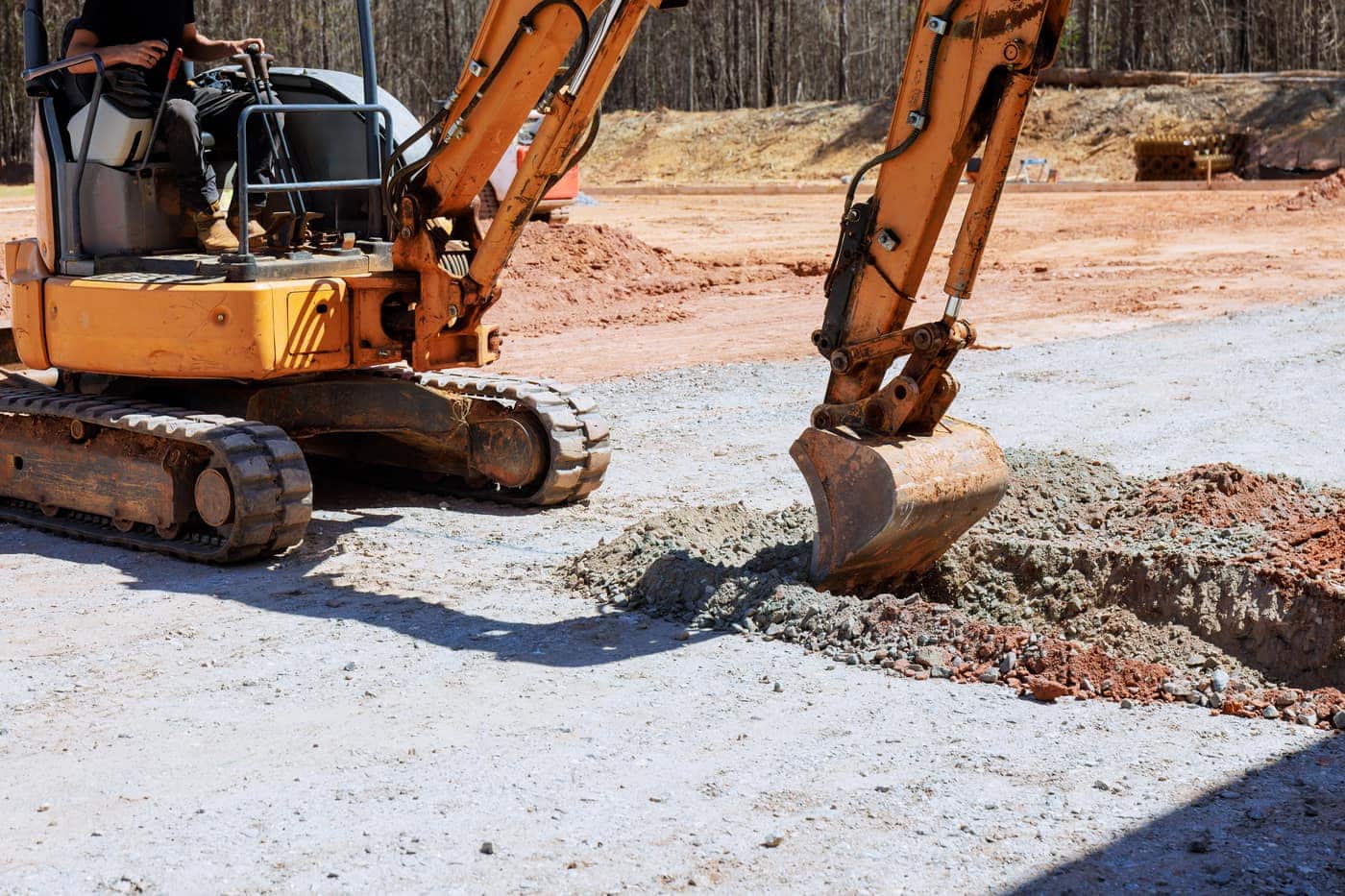
Real-World Scenario: A small crew is trenching for a service when the bucket catches a line that was not where the plan showed it. The operator jumps clear and injures a knee. The utility sends a repair bill, and the business next door loses its afternoon. The owner reports the property damage under general liability and the injury under workers’ compensation on the same day, sends the locate paperwork with both, and lets each adjuster work the part that belongs to that policy.
What made that day manageable was not luck. The owner knew beforehand which policy each question belonged to, had the locate request dated and saved, and did not try to describe the injury to the liability carrier or the line to the compensation carrier.
If you cannot tell which policy a piece belongs to, send the whole account to your agent and ask. Sorting it is easier while the cut is still open and the marks are still on the ground.
A certificate is a summary and not the promise
A certificate tells the reader what your policies said on the day it was printed. It does not add an insured, raise a limit or waive a right. If the bid calls for any of those, the change has to be made on the policy, by endorsement, before the certificate can honestly show it.
That order matters when bid day is close. Endorsements are requests to a carrier, and a carrier can take time or say no. The safe habit is to send the insurance pages of the bid to your agent as soon as you decide to price the job, while there is still room to change the bid or walk away.
Watch for wording that asks the certificate to say what it cannot, such as a promise to notify the holder before any policy change. Your agent can tell you what the carrier may agree to, and the contract can be corrected to match.
Where state rules enter, and where to look them up
Workers’ compensation differs by state, and the contract in front of you can shape what is asked of general liability, so the pair may not read the same from job to job. Who must carry workers’ compensation, how an owner is treated and whether a state runs its own insurer are answers that belong to each state. Look them up for the state where the crew will dig. A worked example is the Massachusetts cost guide, which follows one state’s owner and helper questions.
The excavation insurance by state list leads to every state we serve, with the offices to ask. For a name beyond that list, the U.S. Department of Labor publishes the state officials who handle workers’ compensation.
Federal safety rules sit beside all of this rather than inside it. OSHA publishes the excavation standards for trench and excavation work, and an exhibit may mention them. Meeting them is your crew’s job, and insurance does not stand in for it.
Subs, borrowed hands and the space between the two policies
The gap between the pair shows up where the people on your site are not plainly yours. A subcontractor with no workers’ compensation, a hand supplied by another company, a cousin helping for a week: each can leave a carrier asking whose employee that was, and the answer may not be the answer you expected.
Read a sub’s certificate the way yours is being read: is the named insured the company on the subcontract, are both policies listed, and does either expire before the job ends? If a sub has no employees, ask how the state treats that and how your own carrier may treat it at the end of the term. A short email to your agent settles more of this than a long clause in a subcontract.
Put the same questions to the party above you. If you are the sub on a job, the general contractor may be asking you for what you could ask of the companies beneath you, and the wording in their exhibit can be a starting point for your own.
Reading an insurance exhibit line by line
Read the exhibit with the policies beside it, and mark each line as met, not met or unclear. The unclear pile is the useful pile. Those are the sentences to send to an agent with the question written out, because the answer may depend on an endorsement the exhibit never names.
Then look past the pair. An exhibit can also call for commercial auto, for an umbrella that lifts a total limit, or for contractors equipment when a lender or a lease is involved. General liability and workers’ compensation come first here because they are written for different losses, not because they are written for all of them.
What the exhibit adds also has a price, and the estimating guide shows where to put it. Owners comparing quotes in a single city can look at how the factors stack up in our Salt Lake City cost post.
What to send before bid day
Send enough that nobody has to guess. A complete package lets an agent compare the exhibit with the policies in a single reading, and it leaves time for the endorsements that take longer.
- The insurance pages. The whole exhibit, not a summary of it, with the contract’s indemnity section if there is one.
- The scope. What your crew will dig, how deep, and beside what.
- The current declarations. General liability, workers’ compensation and anything else in force.
- The people. Payroll by job for this work, and the subs you plan to use.
- The deadline. The day the certificate has to be in someone’s hands.
If a policy name in the exhibit is unfamiliar, the SBA’s business insurance guide defines the main ones. Attach the pages to a quote request, and say in it which lines you marked unclear.