
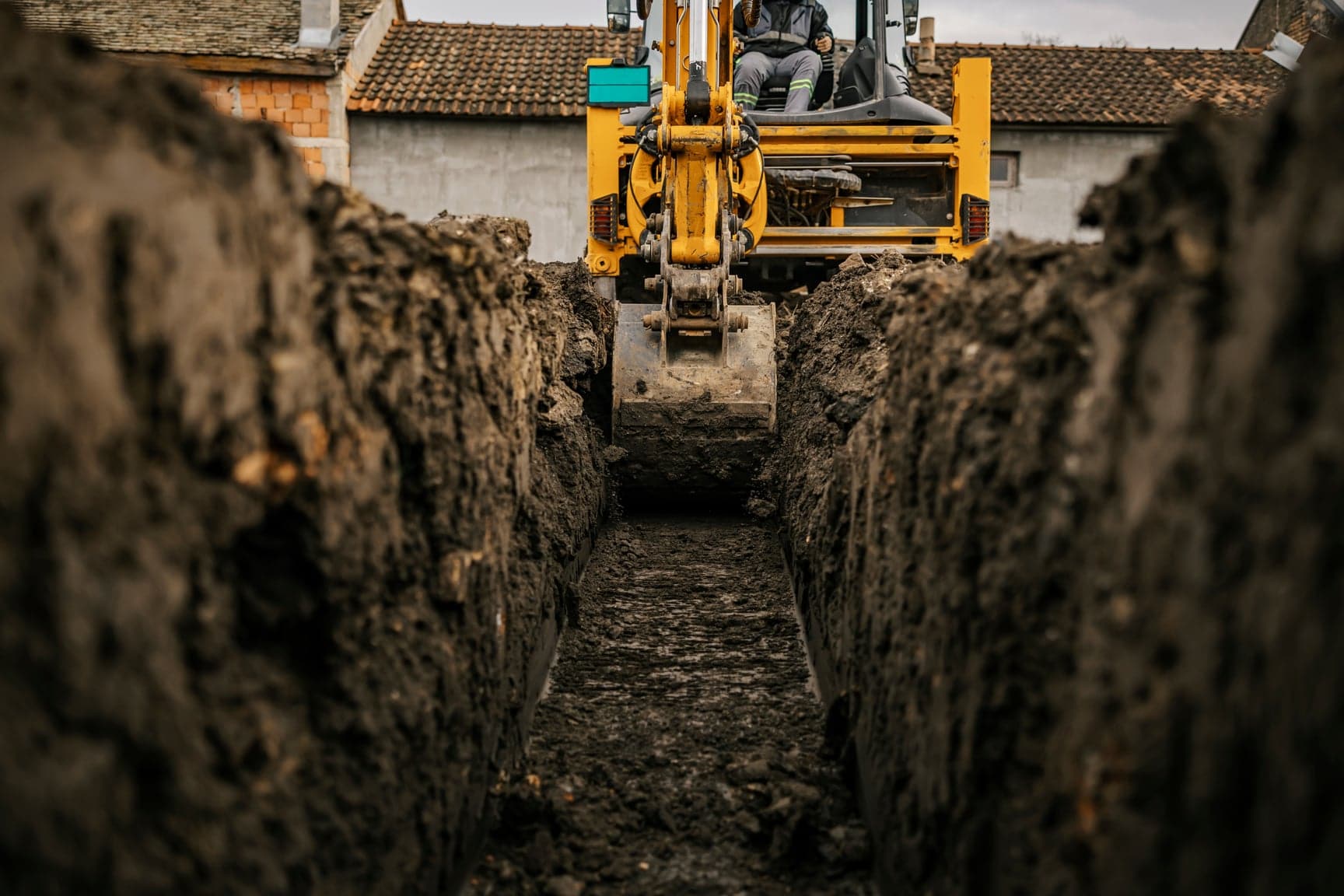
Louisiana puts the first move on the person digging: a notice to the regional center that serves the work area, before the bucket goes in. Two more rules reach an excavation company. The statute that defines a contractor lists grading and excavation work, and the workers’ compensation title says an employer shall secure compensation for the people on the payroll.
Your next step is to put those three rules next to your own jobs: the cuts you make, the crew you employ and the trucks you run. When that picture is ready, bring it to a conversation about excavation insurance and we will build the program from your actual work.
Serving notice on the regional center before a Louisiana cut
The excavation statute is written as a duty on the person who digs: “prior to any excavation or demolition, each excavator or demolisher shall serve telephonic or electronic notice of the intent to excavate or demolish to the regional notification center or centers serving the area” (Louisiana excavation statute). The timing sits in the same text. The statute words the window this way: “at least forty-eight hours, but not more than one hundred twenty hours, excluding weekends and holidays, in advance of the commencement of any excavation or demolition activity”.
The statute’s definitions section describes an excavator as any person who engages in excavation operations (Louisiana definitions). On a job with a prime contractor, a subcontractor on the machine and a hired operator, agree in writing, before mobilizing, which company serves the notice, and keep that agreement with the contract.
The one-call center describes itself as a service that notifies underground utility operators of an intended dig. Start from the center’s site to reach it; it is the center the notice goes to for the work area.
A written note of every notice earns its keep when a claim comes. Record the date, how the notice was served, who served it and the job address, and keep it in the job folder. An agent, an adjuster or a general contractor who asks how the notice was handled can then be answered from paper rather than memory.
A left-to-right diagram: notice is served on the regional center, the underground operators are told of the work, a machine and a buried line meet, and the application, limits and contract are weighed. No figures are shown.
A torn service line and the papers a claim starts from
When a machine opens a neighbor’s service line or a utility’s main, the harm lands on someone else’s property. What a policy takes up turns on the work your application described, the limit you chose and the terms of the contract you signed for the job. It is the wording that is read, and it is read after the fact.
That makes the application the first document in a claim. An application that lists grading and pad work but leaves out trenching near buried utilities describes a different risk than the one your crew runs. Say what the crew does, with which machines, and whether subcontractors dig on your behalf. General liability may respond to a neighbor’s damage on its terms, and the limit on the policy is the room it has to do so.
A bid that names who is responsible for locating and protecting buried facilities is worth reading before you sign it. Your agent can match that clause to the policy wording while the bid is still open, and can tell you what the policy asks of you when a loss is reported. The notice note, the contract, the machine and operator records and photographs of the cut are the papers that tell the story.
The State Licensing Board for Contractors and the grading and excavation wording
The contractor-licensing statute defines a contractor to include a person undertaking this kind of work: “Any building, highway, road, railroad, sewer, grading, excavation, pipeline, public utility structure, project development, housing, or housing development” (Louisiana contractor definition). The issuer is the Louisiana State Licensing Board for Contractors.
Take your next pad, road base or utility trench to the Board’s site before you price it, and ask the Board for the threshold and for the classification that fits the job. A subcontract that requires proof of a license, or a public owner that asks for one, will point at the same office.
The Board’s answer also belongs on your insurance application. An underwriter may ask how the company is licensed and for what kind of work, and an application that matches the Board’s classification reads cleanly from the first page.
Louisiana’s secure-compensation section and what it leaves unanswered for your payroll
Louisiana states the employer’s duty plainly: “An employer shall secure compensation to his employees in one of the following ways” (Louisiana workers’ compensation title).
A head-count threshold before the duty applies is unconfirmed, and so is how the state treats an owner who runs a machine and wants to be on, or off, the policy. No Louisiana workers’ comp office is named, so ask your agent about both, and bring your payroll with you.
On the application, the work each person does matters as much as the head count. A crew that digs, hauls and grades is not described the way an office staff is, and the payroll you report may be reviewed against what the crew really does. Workers’ compensation insurance may answer the duty on its terms; ask your agent how the wording fits your payroll.
Haul trucks on Louisiana plates: the printed property damage and injury limits
The motor vehicle liability statute prints minimum financial-responsibility limits in these words:
“Not less than twenty-five thousand dollars for damages to the property of others, and (b) Not less than fifteen thousand dollars on account of injury to or death of any one person.” (Louisiana motor vehicle liability statute)
A separate commercial-vehicle minimum is unconfirmed, and no Louisiana auto office is named, so ask your agent about dump trucks and tractor-trailers.
Whatever the minimum, a truck schedule is built from the units themselves. List each dump truck, pickup, flatbed and trailer with how it is used, where it is garaged and who drives it. A hired driver, a leased truck or a subcontractor’s unit on your site may sit differently on the policy than a truck you own, so mention them on the application.
A stack of labeled layers, top to bottom: Louisiana call-before-you-dig center; Louisiana State Licensing Board for Contractors; Your agent, with each reply. No figures are shown.
Louisiana’s statutes laid against the policies on your schedule
General Liability: the neighbor’s line and the contractor definition in the licensing chapter
A Louisiana utility or neighbor may look to general liability after a cut, and the work your application described is the first thing read. A job that falls inside the contractor definition in the licensing chapter is a job the underwriter may ask about by name. The policy may respond to damage to someone else’s property or to injury on its terms, and the limit sets the room. Your general liability insurance should name the trenching, grading and site work your crew actually does, along with any digging you hire out, so the description and the work match when a claim comes.
Workers’ Compensation: the employer’s duty to secure compensation
The compensation duty quoted earlier is the one an excavation company has to answer, and a policy is one of the ways the statute lists. The wording is built on how the payroll is described, so the work each person does matters. Subcontractors need attention here too, because a subcontractor without its own program can leave the question of whose payroll it is for you to answer. Bring the crew’s duties and your subcontractor list to a conversation about workers’ compensation, and take the payroll threshold and owner questions to your agent.
Commercial Auto Insurance: dump trucks and pickups against the printed statute
The statute prints its liability minimums, and the dump trucks that haul spoil and the pickups that carry tools each need their own review. Flatbeds and trailers belong on the schedule too, along with who drives each unit and where it sits at night. Longer hauls add miles and drivers, and each one is a question on the application. Your commercial auto insurance is reviewed unit by unit rather than by a minimum alone.
Contractors Equipment Insurance: the machines and the trailer that moves them
The machines are the business. A single machine is worth more than the pickup that tows it, and a loss to one can stop a job. Contractors equipment insurance is the line that may respond to physical loss of the equipment on its terms, including the attachments and the tools kept with it. Describe each machine, how it travels between jobs and where it is stored, since the policy wording is read against those facts. Rented iron and iron you lend to a subcontractor are worth raising with your agent as well.
Umbrella Insurance: a second layer over the primary limits
A cut that takes out a main feeding a neighborhood can produce a loss larger than the general liability limit. Umbrella insurance sits above the primary lines and may respond when those limits are used up, on the terms of the umbrella itself. Public owners and prime contractors may write a minimum limit into a bid, and an umbrella may help a company meet that clause without raising every underlying limit. Learn which underlying policies the umbrella follows and where its exclusions begin before you sign.
Property Insurance: the building where the crew starts its day
Where the machines are kept is itself a risk. Property insurance looks at the shop or office, the fuel tank, the parts room and the tools and stock kept inside, and the policy wording is read against what the building holds. List the structures, the contents and anything stored in the open yard, then ask your agent how each is treated. All six lines can be reviewed together through our quote request.
Dirt work an application may ask a Louisiana contractor to describe
An application asks what the crew does with a bucket, a blade and a hose, and an answer that fits one kind of job may not fit another. The kinds of excavation work below are how an underwriter may read them, and each one deserves its own sentence on the form.
Digging that opens ground: footings, ponds and borrow pits
General excavation is moving earth to open a site: a footing line, a retention pond, a cut for a road. An application may ask what you dig, how deep and near what, and who hauls the spoil away. Your answer may help an underwriter see whether the cut stays on your own ground or reaches a neighbor’s.
Shaping a pad: land grading for a builder or a lot
Grading brings a site to the shape a builder needs. The application may ask which machines do the shaping, whether you also set stakes or only run the blade, and whether you work for a builder, an owner or a public agency.
Preparing the ground: site preparation before the slab or the road
Site preparation is the work that comes before the footing: stripping, compacting and leveling. It is a different line item from a trench, and an underwriter may read the two apart, so list it separately when you do both.
Trenches for pipe, conduit and cable
Utility and trench work is the cut that goes near buried facilities. This is the work where the notice, the marks and the written note of both carry the greatest weight in the insurance conversation, and where an application may ask who locates the line and who backfills.
Cutting for a foundation or a below-grade room
Foundation digging opens ground against an existing wall, a lot line or a street. The application may ask how close the cut sits to neighbors and whether shoring is part of the job.
Vacuum work: hydro excavation near buried lines
Hydro excavation clears soil with water pressure and a vacuum truck, so a line can be seen before a bucket reaches it. Owners who search for a hydro-vac company in Louisiana are asking how that work sits on the same program as the trencher, and the answer starts with describing the vacuum truck and the crew that runs it.
What an underwriter may ask a Louisiana grading and site-prep outfit
Searches for land grading in Louisiana and site preparation in Louisiana come from owners who want to know where the work fits on a policy. The application is the answer. It may ask what machines you run and who owns them, how large the crew is on the machines and the ground, which jobs you subcontract and what the subcontractors carry, how far the spoil is hauled and where the crew is based.
It may also ask whether you bid public work, whether a utility owner or a general contractor writes the contract, and whether any of the digging happens near buried facilities. Honest, specific answers let an agent place the work on the right policy line, and a loose answer on a form can become a hard question during a claim.
Owners who type contractor insurance in Louisiana, contractors insurance Louisiana or construction insurance Louisiana into a search box are asking the same question from another angle: what does the program for a company like mine look like? For an excavation company it is the policies above, written around the work the application describes. Bring your last year of jobs, the machines on each and the people who worked them, and the answer gets specific quickly.
Where to take each Louisiana question, and the topics with no office to name
Two bodies are named for Louisiana. For serving a notice and reaching the facility owners, start at Louisiana 811, the one-call center. For whether a job puts your company inside the contractor definition and which classification fits, ask the Louisiana State Licensing Board for Contractors, which licenses contractors.
Workers’ compensation and commercial auto have no Louisiana office named, so those questions go to your agent. Write down what you asked and who answered, and keep it with the job folder.
Insurance paper in a Louisiana prime contract, a parish bid or a first job
Prime contractors and public owners write their insurance wants into the contract: a certificate, a stated limit, an additional-insured endorsement, a waiver of subrogation. The contract is where you read it, well before the first load of dirt moves. Send the contract to your agent with the quote request and ask which items the program already meets and which need an endorsement.
A subcontractor on your site is another set of papers. Ask for its certificate before it starts and keep it in the job folder, along with the written note of who serves the Louisiana notice. A new excavation business may have few papers to hand over, so begin the folder with the first job rather than the tenth, and add each contract, certificate and notice note as it comes in.
A Louisiana job-binder checklist
Before the next job, confirm that the notice is served and noted, that the contract says who is responsible for buried facilities, and that the Board has answered the license question for the job. Check that the payroll on the application matches the crew, that every truck and trailer is on the schedule, and that each machine is described. Then send it all along with your quote request.
Keep a short list beside it of what the job will ask of the crew: the cut and its depth, the machines on site, the subcontractors who arrive, the loads that leave. An agent who sees that list can match each line to a policy and point out the ones that need a closer look before the work starts.
What Louisiana leaves open, and the links behind each rule
Each statute and each body above is linked in the list at the end. Three questions remain for your agent: a payroll threshold for the compensation duty, whether an owner may be on or off the policy, and a commercial-vehicle minimum for the trucks.