
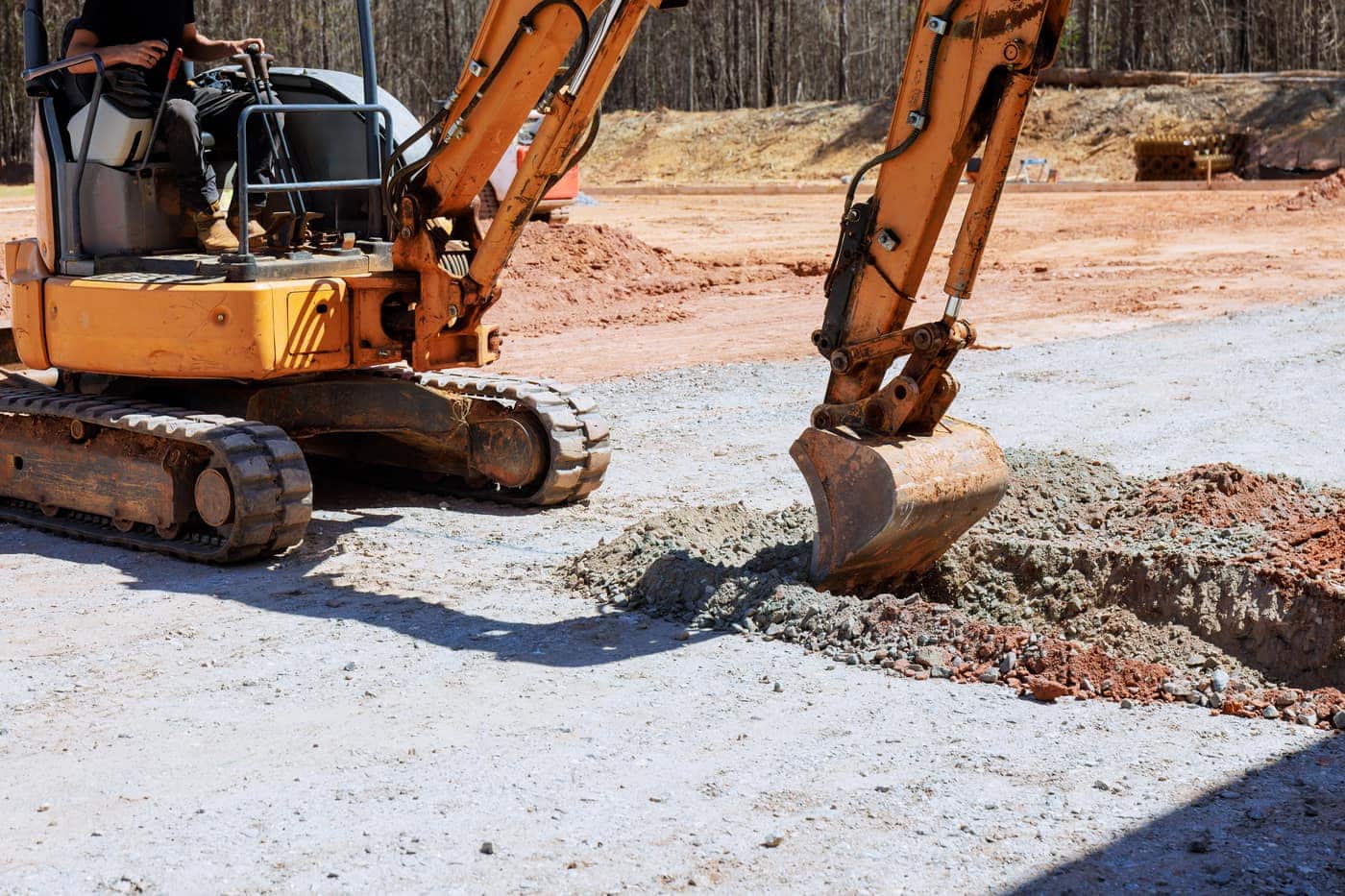
Connecticut’s underground utility chapter puts a plain duty on the people running a dig. It reads: “a person, public agency or public utility responsible for excavating, discharging explosives or demolishing shall notify the central clearinghouse of such proposed excavation, discharge or demolition” (Connecticut General Statutes). Beyond that notice, the state’s published rules reach an excavation crew through a home improvement registration kept by the Department of Consumer Protection, an employer’s duty to secure workers’ compensation, and the amounts printed in the financial-responsibility statute for vehicles.
Read the notice rules first, then the registration, the compensation duty and the truck amounts, and carry the open questions to the agencies named near the end. When your papers are in order, our quote form lets us build an excavation insurance program around the cuts your crew makes, the machines that make them and the trucks that haul away the spoil.
The central clearinghouse and the Public Utilities Regulatory Authority
The statute sets up the body that takes the call: “The public utilities of the state shall, under the direction of the Public Utilities Regulatory Authority, organize and operate a central clearinghouse within the state” (Connecticut General Statutes). The Public Utilities Regulatory Authority publishes a call-before-you-dig provisions page, and it states the timing this way: “at least two full days, excluding Saturdays, Sundays and holidays, but not more than thirty (30) days” (Public Utilities Regulatory Authority). We have not found a marketed name or web address for the clearinghouse itself; the Public Utilities Regulatory Authority is the place to ask how a call is placed.
On who must call, the chapter defines a person broadly. The definition takes in individuals, partnerships, corporations, limited liability companies and associations, and it includes a contractor engaged by a public agency. An owner who hires out trenching should settle in the subcontract which company places the call, and put that choice in writing before the machine arrives.
A written note of each notice does its work later, in the insurance conversation. When a reviewer opens a claim after a strike, the date, the time, the confirmation you were given and the name of the employee who placed the call show what the business did before the machine moved. File the note with the contract and the work order for that job, so it can be found without a search, and teach every foreman where those papers live.
A flow for a Connecticut dig: the call to the central clearinghouse is logged, the machine reaches a buried facility, a service line is opened, and an adjuster may compare the application and the contract. No figures are shown.
A cut line on a Hartford job: where the policy wording comes in
A buried gas or utility line struck by a machine heads the list of claims an excavation business fears, along with other damage to a neighbor’s property. Whether a Connecticut policy responds to such a loss depends on its wording: how the application described your work, which limits were bought and which contract put your crew on the site. General liability may respond to third-party property damage on its terms, and the agent who placed the policy is the person to read those terms with you.
After a strike, the same handful of questions get asked. Who was the work for? How did the application describe it? Which machine was running? Was the notice placed, and does a note show it? The answers sit in your own paperwork, so keep the work order, the daily log and any photographs together from the day a job begins.
If a line is damaged, the first calls may go to the facility operator and to your agent. The claim then follows the policy’s own notice conditions, which an agent can walk through before a loss. Read those conditions while the job is quiet, so the crew knows what to report and how quickly when a bucket meets something it should not.
Home improvement registration at the Department of Consumer Protection
On excavators, the Department of Consumer Protection states: “Contractors are required to have a Home Improvement Registration to perform excavation work in family dwellings of 1-6 units” (Department of Consumer Protection). The route it names is the Home Improvement Registration, issued by that department for excavation work in family dwellings.
Whether excavation work on commercial ground, public work or other sites calls for a different license is unconfirmed. The Department of Consumer Protection can tell you which credential fits your jobs, and the contract with the property owner or general contractor may spell out its own credential wording. Settle that before the application goes in, because the work you describe to an insurer should match the work you are permitted to take.
The Workers’ Compensation Commission and the employer’s duty to secure compensation
The compensation chapter states the duty in these words: “but an employer shall secure compensation for his employees as provided under this chapter” (Connecticut General Statutes). The chapter also lists insurance through authorized stock or mutual companies or associations among the routes an employer may use.
The employee threshold that brings an employer under the chapter and the question of an owner or officer electing in or out are both unconfirmed; the Workers’ Compensation Commission is the body to ask. When you request terms, give your agent a plain account of what each person on the crew does in a day, from running the machine to hauling spoil to working in the cut, because the application may ask about each role and about payroll as the crew grows.
Hiring changes the picture, so tell your agent before a new operator or laborer starts rather than after. Subcontracted labor deserves the same attention: ask each sub for proof of its own compensation arrangements, and keep that proof with the subcontract.
Trucks on Connecticut roads: the amounts the statute prints
The financial-responsibility statute states amounts that bear on any vehicle your business puts on the road. It reads:
“personal injury to, or the death of, any one person, of twenty-five thousand dollars, or by reason of personal injury to, or the death of, more than one person on account of any accident, of at least fifty thousand dollars, and for damage to property of at least twenty-five thousand dollars” (Connecticut General Statutes)
A separate minimum for commercial vehicles or dump trucks is unconfirmed. Your agent can say what limits an insurer may write for your trucks, and the contract for a job may ask for more than any statute prints. The vehicles worth scheduling are the ones that carry your business: the dump trucks that haul spoil, the pickups that carry the crew and tools, and the trailers that move a machine from one site to the next.
Equipment that is driven on a road and operated on a site can sit in two parts of a program, so ask your agent which policy answers for each machine and how a trailer is treated while it is hitched. Give the driver list to your agent as well, so the application reflects who actually drives each truck, and report a new driver before that person takes a keys-in-hand assignment.
A stack of labeled layers, top to bottom: Connecticut call-before-you-dig center; Public Utilities Regulatory Authority; Connecticut Insurance Department; Workers’ Compensation Commission; Department of Consumer Protection; Your agent, with each reply. No figures are shown.
What each Connecticut coverage line means for a bucket and a crew
General Liability
For a Connecticut dig crew, general liability is the line the lead claim runs through: a bucket takes out a neighbor’s service line, a trench undermines a driveway, spoil buries a fence. It may respond to that damage on its terms, once the application, the limits and the contract are read side by side. Connecticut’s call-before-you-dig duty sits beside the policy rather than inside it, so the note of each notice belongs in the folder you hand to your agent and to any adjuster who asks for it.
Workers’ Compensation
Workers’ compensation answers to the employer’s duty stated in the compensation chapter. An excavation crew works around moving machines, open cuts and heavy loads, so the application may ask who operates what and who works down in the trench. The threshold and the owner election are unconfirmed, so take those two points to the Workers’ Compensation Commission and to your agent before payroll is reported.
Commercial Auto Insurance
A dump truck leaving a site loaded with spoil, a pickup towing a skid trailer and a service truck carrying fuel are the vehicles commercial auto is built around. The financial-responsibility amounts are quoted above, and the commercial-vehicle minimum is unconfirmed. Schedule every vehicle the business runs, list the drivers, and ask how a vehicle owned by an employee but used on a job is treated under the policy.
Contractors Equipment Insurance
The excavators, backhoes, skid steers and compact loaders that cut Connecticut ground are the tools the business earns with. Contractors equipment is written on a schedule of the machines, and the application may ask for each machine’s description and value. Ask where a machine is protected while it sits in a yard, travels on a trailer or works on a customer’s site, and how a rented machine is handled when the rental agreement puts it in your care.
Umbrella Insurance
A serious loss on a job may call for more than the underlying liability policy holds, which is the question umbrella is meant to answer. It adds limits above the underlying liability lines if the program carries it, and it follows its own terms and exclusions. A general contractor or public owner may write a limit into the contract, so read that clause before you bid and tell your agent about it when you request terms.
Property Insurance
A shop with a fuel tank, a storage building for attachments or a rented yard holds property that stays put while the machines are away. Property insurance may respond to loss of a building or its contents on its terms, and the application asks what the business owns versus rents. Tell your agent about fuel, tools and spare parts kept on site, and about any building the business leases, since the lease may allocate responsibility for repairs.
To compare these six lines against your own jobs, send a quote request describing the work.
Kinds of dig work to name when a Connecticut quote is requested
A quote request goes more smoothly when every kind of job is named in plain words. These are the six an owner may be asked about.
General excavation work
Digging out and moving earth as a job in itself. The application may ask how deep the cuts go, who owns the land and which utilities cross it, and a contract for the work can carry its own insurance wording.
Grading for building pads
Shaping and leveling a lot so a house or a commercial building can be set. Describe the machines, the hauling of fill, whether the work is for a builder or a property owner, and whether a neighbor’s boundary is close to the work.
Site preparation
Stripping topsoil and readying the ground for the trades that follow. Name any work done for other contractors on the same site, because a site with several companies on it raises questions about whose crew did what.
Trench and utility runs
Opening a trench for water, sewer, gas or electric lines, then backfilling it. This is the work nearest the buried facilities that drive the lead claim, so the note of the notice carries the greatest weight here, and the application may ask how a crew confirms where a line runs.
Foundation and basement cuts
Digging for a basement or a foundation beside neighboring buildings. Tell your agent how close the cut sits to a neighbor’s wall or driveway, whether shoring is used and who owns the machine placed beside the edge.
Hydro excavation
Opening ground with water and vacuum to expose a line before a machine cuts near it. Say whether you own the truck or hire it, since the vehicle and the work may each draw a question on the application.
Describing the work, machines and haul on a Connecticut application
An insurer may read an application as a picture of the business, so give it a true one. Name the kinds of work above that you take, and say which you do not. List the machines and attachments, the trucks and the trailers. State how many people work on site and how many in the office, and whether any labor is hired through subcontractors. Say where spoil goes and who hauls it.
Describe the sites you work as they are: residential lots, commercial pads, roadside utility trenches or farm and open land. If a share of your work is for one general contractor, say so. A description that matches the contracts you sign is easier to defend later, and a mismatch between application and contract is what an adjuster may compare after a loss.
Answer the questions about subcontractors with the same care. If a trenching sub or a hauler works under your name, the application may ask how you check its insurance and whether you hold its certificate. If the crew grows during the year, tell your agent when it happens, so payroll and equipment stay in step with the business as it runs.
Reaching the Connecticut agencies by name
For the clearinghouse and the notice, ask the Public Utilities Regulatory Authority. For licensing, ask the Department of Consumer Protection, which publishes the excavator statement quoted above. For workers’ compensation, ask the Workers’ Compensation Commission. The Connecticut Insurance Department is the insurance regulator, so ask it.
Questions about the commercial-vehicle minimum, a rented yard or a specific contract do not belong to any of these four. Take those to your agent or to the party whose contract your crew signs.
Insurance wording in Connecticut subcontracts and town bids
A builder, a developer or a town may request a certificate of insurance, and its contract may carry wording such as additional insured status, higher limits, a waiver of subrogation or an indemnity clause. Take each clause to your agent before signing and again when you request terms. A certificate is a summary issued by the agent, and the policy and its endorsements control.
A new excavation business may face more questions than an established one, since there is no loss history to read. Gather your experience, your equipment list and any subcontractor certificates you hold. If you hire a trenching or hauling sub, ask for its certificate and its own compensation proof before it starts, because an uninsured sub may become a gap in your own program.
Papers to pull together before asking for terms
- The notes of your clearinghouse calls on recent jobs, and the way your crew writes them.
- The contracts you are signing, with their insurance clauses marked.
- A list of machines, attachments, trucks and trailers, with how each is used.
- Payroll by job role for the crew you have and the crew you plan to hire.
- Certificates from every subcontractor and hauler you use.
- Any answer you have from the Department of Consumer Protection about a credential.
What the Connecticut citations state, and what to ask
Each rule above is linked beside its quote: the underground utility chapter, the authority’s call-before-you-dig provisions page, the Department of Consumer Protection’s excavator statement, the compensation chapter and the financial-responsibility statute. Four points are unconfirmed. Ask the Public Utilities Regulatory Authority for the clearinghouse’s address, the Department of Consumer Protection about any credential for work outside family dwellings, the Workers’ Compensation Commission about the employee threshold and owner election, and your agent about a commercial-vehicle minimum. The quote form is the place to start a conversation about the program itself.